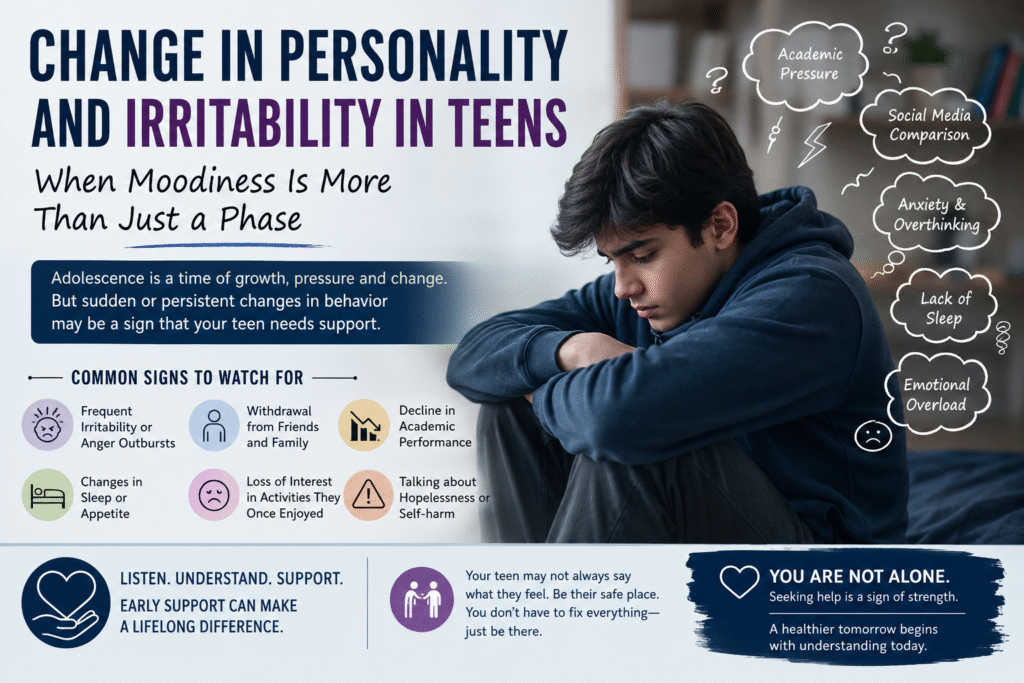
Teenagers are often described as “moody,” “rebellious,” or “difficult.”
And yes — adolescence naturally comes with emotional ups and downs.
But sometimes, parents notice something deeper:
“My child is not the same person anymore.”
A once cheerful teenager becomes withdrawn.
A calm child suddenly turns angry and explosive.
A bright student starts avoiding everyone.
Small conversations turn into arguments.
Simple requests trigger irritation.
These changes can leave parents confused, guilty, frustrated, and worried.
In many cases, personality changes and irritability in teens are not simply “attitude problems.” They may be signs of emotional distress, mental health conditions, stress overload, trauma, bullying, substance use, or underlying psychological struggles.
As psychiatrists and mental health professionals, we often see families seeking help only after months — or even years — of conflict, assuming the teen is “just going through a phase.”
Sometimes they are.
Sometimes they are silently suffering.
Understanding Personality Changes in Teenagers
Adolescence is a period of major brain development, hormonal shifts, identity formation, academic pressure, and social comparison.
The teenage brain is still developing — especially the part responsible for:
- Emotional regulation
- Decision-making
- Impulse control
- Planning
- Managing frustration
Because of this, emotional intensity is common.
However, significant or persistent personality changes should not be ignored.
What Does “Change in Personality” Look Like?
Parents often describe it like this:
- “He used to talk to everyone. Now he stays locked in his room.”
- “She becomes angry over tiny things.”
- “He has become rude and emotionally cold.”
- “She cries very easily nowadays.”
- “He suddenly stopped enjoying cricket and gaming.”
- “She reacts aggressively if we ask basic questions.”
- “He looks emotionally numb.”
- “She has become suspicious and defensive.”
These shifts can happen gradually or suddenly.
Common Signs of Irritability in Teens
Irritability is more than occasional anger.
It may include:
- Frequent arguments
- Low frustration tolerance
- Snapping at family members
- Passive-aggressive behavior
- Angry outbursts
- Sarcasm and hostility
- Throwing objects
- Self-harm threats
- Emotional shutdown
- Extreme sensitivity to criticism
Sometimes irritability is actually a hidden form of depression or anxiety.
In teenagers, depression often looks less like sadness and more like:
- Anger
- Irritation
- Defiance
- Social withdrawal
- Emotional numbness
This is something many families do not realize.
Why Do Teens Become Irritable or Change Suddenly?
1. Academic Pressure
In India especially, teenagers often face enormous pressure regarding:
- NEET
- JEE
- Board exams
- Career expectations
- Comparisons with cousins or peers
Many teens feel trapped between parental expectations and their own emotional capacity.
A 16-year-old boy once told me:
“Nobody asks whether I’m okay. Everyone only asks about marks.”
That sentence reflects the emotional exhaustion many teenagers experience silently.
2. Depression in Teens
Teen depression may appear differently than adult depression.
Instead of obvious sadness, teenagers may show:
- Irritability
- Anger
- Loss of motivation
- Excessive sleep
- Isolation
- Poor concentration
- Declining grades
- Hopelessness
According to the World Health Organization, depression is one of the leading causes of illness and disability among adolescents worldwide.
3. Anxiety Disorders
Teens with anxiety may become irritable because their minds are constantly overwhelmed.
They may worry about:
- Failure
- Rejection
- Appearance
- Social judgment
- Future uncertainty
An anxious teen may appear “short-tempered,” but internally they may be emotionally exhausted.
4. Social Media and Digital Stress
Modern teenagers live under constant comparison.
Social media can amplify:
- Body image issues
- Fear of missing out (FOMO)
- Relationship insecurity
- Cyberbullying
- Validation-seeking
- Sleep disruption
A teenager may look “lazy” or “irritable,” but may actually be staying awake till 3 AM scrolling, comparing, and overthinking.
5. Bullying or Peer Rejection
Many teenagers hide bullying from parents.
Signs may include:
- Refusing school
- Mood changes after using the phone
- Isolation
- Anger
- Sudden drop in confidence
Sometimes irritability becomes a defense mechanism.
6. Hormonal and Biological Changes
Hormonal fluctuations can increase emotional sensitivity.
Sleep deprivation also worsens mood regulation dramatically.
Teenagers today often sleep very late due to:
- Mobile use
- Academic stress
- Gaming
- Anxiety
- Social media
Poor sleep alone can increase:
- Irritability
- Emotional reactivity
- Aggression
- Poor concentration
7. Trauma or Family Conflict
Teens exposed to:
- Frequent parental fights
- Emotional neglect
- Abuse
- Divorce conflict
- Alcoholism in family
- Loss of loved ones
may develop behavioral and emotional changes.
Sometimes anger becomes a mask for emotional pain.
8. ADHD and Emotional Dysregulation
Teenagers with Attention-Deficit/Hyperactivity Disorder may struggle with:
- Impulsiveness
- Emotional overreaction
- Frustration intolerance
- Sudden anger
- Academic underperformance
They are often misunderstood as “lazy” or “disrespectful.”
9. Substance Use
Some teenagers experiment with:
- Nicotine vaping
- Alcohol
- Cannabis
- Other substances
Substance use can worsen:
- Mood swings
- Aggression
- Isolation
- Motivation problems
Sudden personality changes should never ignore this possibility.
When Should Parents Be Concerned?
Seek professional evaluation if changes:
- Persist beyond several weeks
- Affect school performance
- Damage relationships
- Include self-harm behavior
- Include suicidal thoughts
- Cause severe anger outbursts
- Lead to social withdrawal
- Include suspiciousness or extreme emotional changes
Early intervention matters.
What Parents Should Avoid
Avoid:
- Constant criticism
- Comparing with siblings
- Calling them “dramatic”
- Public humiliation
- Excessive punishment
- Invalidating emotions
- Lecturing during emotional moments
Statements like:
- “You have everything, why are you upset?”
- “In our time we never behaved like this.”
- “Stop overreacting.”
may unintentionally increase emotional distance.
What Actually Helps Teens
1. Listen More, Lecture Less
Teenagers often want understanding before advice.
Sometimes sitting quietly and listening creates more healing than a long motivational speech.
2. Validate Emotions
Validation does not mean agreeing with all behavior.
It means acknowledging feelings.
Instead of:
“This is nonsense.”
Try:
“You seem really overwhelmed lately.”
That single shift changes conversations dramatically.
3. Improve Sleep and Routine
Healthy routines significantly affect mood.
Encourage:
- Regular sleep
- Reduced late-night screen use
- Physical activity
- Nutritious meals
- Outdoor exposure
4. Encourage Emotional Expression
Many Indian families unintentionally teach:
- Boys should not cry
- Anger is strength
- Emotions are weakness
But suppressed emotions often return as irritability, aggression, or emotional shutdown.
5. Seek Professional Help Early
A psychiatrist, psychologist, or counselor can help identify:
- Depression
- Anxiety
- ADHD
- OCD
- Trauma
- Behavioral disorders
- Family stress patterns
Early support prevents long-term worsening.
A Realistic Example
A 15-year-old girl was brought to clinic because her parents described her as:
- “Extremely rude”
- “Always angry”
- “Addicted to phone”
- “Disrespectful”
Over sessions, it emerged that she was being severely bullied about her appearance in school and spending nights crying alone.
Her irritability was not the real problem.
It was emotional pain that nobody had noticed.
This is more common than many people realize.
The Important Thing Parents Must Remember
Not every irritable teen has a psychiatric disorder.
But persistent personality changes are signals worth understanding — not dismissing.
Teenagers today are growing up in a world of:
- Constant comparison
- Academic pressure
- Social media exposure
- Emotional isolation
- Uncertainty about the future
Sometimes their anger is actually anxiety.
Sometimes their silence is depression.
Sometimes their irritability is emotional exhaustion.
And sometimes, what they need most is not punishment — but emotional safety.
FAQs
Is irritability normal in teenagers?
Mild moodiness can be normal due to hormonal and developmental changes. However, severe or persistent irritability affecting daily life should be evaluated.
Can depression look like anger in teens?
Yes. Teen depression commonly presents as irritability, frustration, withdrawal, and anger rather than obvious sadness.
Should parents punish angry behavior?
Boundaries are important, but understanding the underlying emotional cause is equally important. Excessive punishment without emotional support may worsen problems.
Can excessive mobile use worsen irritability?
Yes. Poor sleep, social comparison, overstimulation, and online stress can contribute significantly to mood changes.
When should I consult a psychiatrist?
Consult a mental health professional if personality changes persist, worsen, affect functioning, or involve self-harm, suicidal thoughts, aggression, or severe emotional distress.
Final Thoughts
Teenagers do not always know how to explain emotional pain.
Many express distress through:
- Anger
- Silence
- Isolation
- Irritability
- Defiance
Behind difficult behavior, there is often an overwhelmed mind asking for help in the only way it knows.
Understanding this early can change the course of a teenager’s life.
Disclaimer:
This article is for educational and awareness purposes only and should not replace professional psychiatric or psychological evaluation. If a teenager is experiencing emotional distress, behavioral changes, self-harm thoughts, or severe mood symptoms, consult a qualified mental health professional.
Mind & Mood Clinic
Dr. Rameez Shaikh, MBBS, MD (Psychiatrist & Counsellor)

Dr. Rameez Shaikh (MBBS, MD, MIPS) is a consultant Psychiatrist, Sexologist & Psychotherapist in Nagpur and works at Mind & Mood Clinic. He believes that science-based treatment, encompassing spiritual, physical, and mental health, will provide you with the long-lasting knowledge and tool to find happiness and wholeness again.
Dr. Rameez Shaikh, a dedicated psychiatrist , is a beacon of compassion and understanding in the realm of mental health. With a genuine passion for helping others, he combines his extensive knowledge and empathetic approach to create a supportive space for his patients.