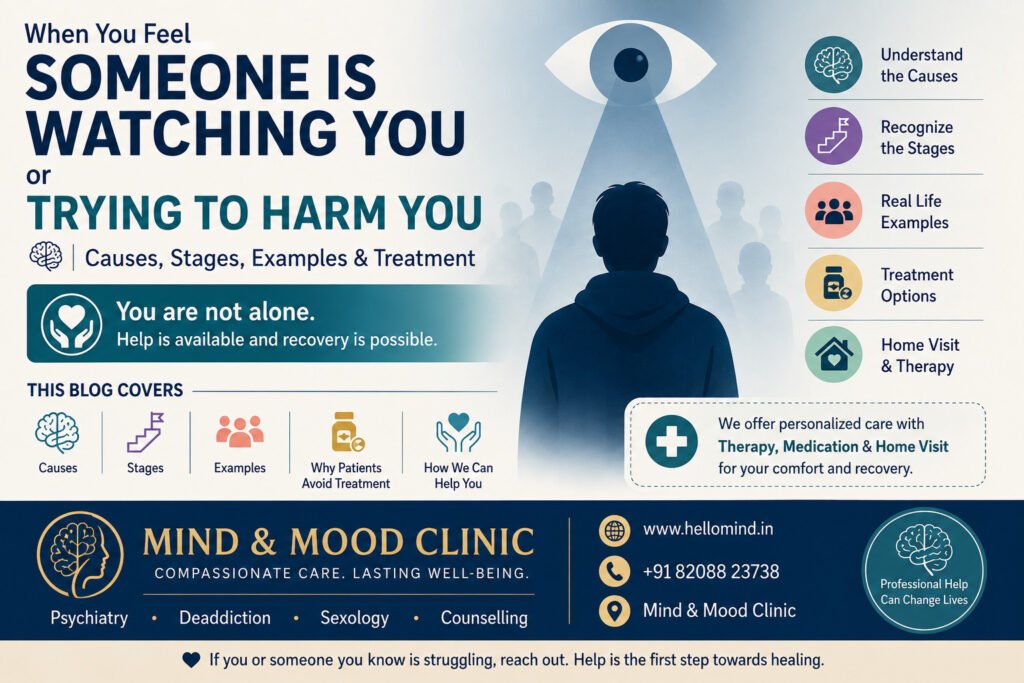
Someone Is Watching Me or Trying to Harm Me: Why Does It Happen?
Have you ever felt:
- “Someone is watching me.”
- “People are talking about me.”
- “Someone is following me.”
- “My neighbours are spying on me.”
- “Someone has installed a camera in my room.”
- “People are trying to harm me.”
- “Someone is putting something in my food.”
- “My phone is being monitored.”
- “My family is secretly planning something against me.”
These experiences can be extremely frightening.
For the person experiencing them, the fear can feel completely real. They may start checking doors repeatedly, avoiding certain people, changing phone numbers, refusing food, staying awake at night, or withdrawing from family and friends.
Importantly, feeling watched or threatened does not automatically mean that a person has a psychiatric disorder. Similar experiences can occur with severe anxiety, prolonged stress, sleep deprivation, trauma, substance use, certain medications, neurological conditions, and psychiatric illnesses.
The important question is: What is causing the experience, and how strongly is it affecting the person’s ability to function?
What Does “Someone Is Watching Me” Mean?
The experience can range from a temporary feeling of insecurity to a persistent belief that other people are deliberately monitoring or harming someone.
For example:
Example 1: Anxiety
A person hears two colleagues talking and thinks:
“Maybe they are discussing my mistake.”
They may feel uncomfortable but can consider other explanations.
Example 2: Severe anxiety
Someone may repeatedly think:
“What if someone is following me?”
They start checking behind them while travelling and repeatedly seek reassurance from family.
Example 3: Suspiciousness
A person may begin believing:
“My neighbours are watching me whenever I leave my house.”
They may start avoiding the neighbours.
Example 4: Strong persecutory belief
A person may become firmly convinced:
“My neighbours have installed cameras specifically to monitor me.”
Even when family members provide alternative explanations, the person may remain completely convinced.
Example 5: Feeling targeted
Someone may believe:
“People at work are deliberately trying to get me fired.”
This can lead to arguments, complaints, social withdrawal, or resignation from employment.
Why Does Someone Feel That Others Are Watching or Trying to Harm Them?
There is no single cause.
The underlying cause needs to be assessed individually.
1. Anxiety and Excessive Worry
Severe anxiety can make the brain constantly scan the environment for danger.
A person may interpret ordinary events as threatening.
For example:
A neighbour closes their door → “They are angry with me.”
Someone looks at them in a shop → “Why are they staring at me?”
A friend does not answer the phone → “Maybe something has happened.”
The person may recognize that these thoughts could be exaggerated.
2. Lack of Sleep
Severe sleep deprivation can significantly affect concentration, emotional regulation, perception and interpretation of events.
Someone who has slept only a few hours for several nights may become:
- Irritable
- Hypervigilant
- Suspicious
- Emotionally overwhelmed
- More sensitive to sounds and movements
In severe cases, perceptual disturbances can also occur.
3. Stress and Trauma
After prolonged stress or traumatic experiences, some people become excessively alert to potential danger.
For example, a person who has previously experienced violence may constantly check:
- Who is behind them
- Whether doors are locked
- Whether someone is following them
- Whether strangers are behaving suspiciously
This can sometimes resemble paranoia but may arise in the context of trauma-related hypervigilance.
4. Depression
Severe depression can sometimes involve suspicious or guilt-related beliefs.
For example:
“Everyone thinks I am useless.”
or, in severe cases:
“My family would be better off without me.”
If suspiciousness or unusual beliefs occur with significant depression, psychiatric evaluation is important.
5. Substance Use
Certain substances can cause or worsen suspiciousness and paranoid experiences.
Examples include:
- Cannabis
- Methamphetamine
- Cocaine
- Some synthetic stimulants
- Certain other recreational drugs
Substance-related paranoia can sometimes persist even after the immediate effects have worn off.
This is one reason it is important for a psychiatrist to ask about alcohol, cannabis, stimulants and other substances without judgment.
6. Psychotic Disorders
Persistent persecutory beliefs can occur as part of psychotic disorders.
A person may firmly believe that:
- Someone is spying on them
- Their phone is being hacked specifically to monitor them
- Their neighbours are plotting against them
- Someone is poisoning their food
- Television or social media contains messages directed specifically at them
These experiences require proper psychiatric assessment.
7. Bipolar Disorder
During severe manic or mixed episodes, some people can develop suspiciousness, unusual beliefs or psychotic symptoms.
Other symptoms may include:
- Very little need for sleep
- Excessive energy
- Rapid speech
- Increased activity
- Irritability
- Impulsive decisions
- Grandiose ideas
8. Medical or Neurological Causes
New-onset suspiciousness, hallucinations or major behavioural changes can occasionally be associated with medical or neurological conditions.
Therefore, particularly when symptoms begin suddenly or later in life, a psychiatrist may recommend appropriate medical evaluation.
Understanding the Stages: How Suspicious Thoughts Can Progress
There is no universally accepted medical staging system for paranoia. However, clinically, symptoms can sometimes progress through a pattern like the following.
Stage 1: Occasional Suspicion
The person occasionally wonders:
“Why did they look at me?”
They can usually dismiss the thought and continue their activities.
Example
A colleague whispers to another colleague.
The person thinks:
“Maybe they’re talking about me.”
But they do not become preoccupied with it.
Stage 2: Repeated Suspicion
The thoughts become more frequent.
The person starts asking family members:
“Did you notice them looking at me?”
They may repeatedly seek reassurance.
Example
A person notices the same car near their workplace twice.
They begin wondering:
“Is someone following me?”
Stage 3: Hypervigilance and Checking
The person starts changing their behaviour.
They may:
- Check windows repeatedly
- Look behind themselves while walking
- Check CCTV
- Change passwords repeatedly
- Avoid certain locations
- Ask family members to accompany them
The fear starts interfering with daily life.
Stage 4: Strong Conviction
The belief becomes increasingly difficult to question.
For example:
“My neighbours are definitely monitoring me.”
Family members may provide alternative explanations, but the person remains highly convinced.
Stage 5: Functional Impairment
The problem begins affecting:
- Work
- Studies
- Relationships
- Sleep
- Eating
- Social activities
- Financial decisions
A person may stop going to work because they believe colleagues are conspiring against them.
Stage 6: Behaviour Driven by the Belief
This is an important stage clinically.
A person may begin taking actions based on their fear.
For example:
“Someone is trying to poison me.”
They may stop eating food prepared by family members.
Or:
“Someone is entering my house.”
They may repeatedly confront neighbours.
This is one reason early psychiatric assessment can be extremely helpful.
Why Are People Reluctant to Take Psychiatric Medication?
This is extremely common.
A person experiencing suspicious thoughts may say:
“I don’t need psychiatric treatment. The problem is with other people.”
This does not necessarily mean they are refusing help deliberately.
Their experience may feel completely logical and real to them.
Common reasons include:
“I’m not mentally ill.”
They may believe:
“If someone is actually following me, why should I take psychiatric medicine?”
Fear of side effects
People may worry about:
- Sleepiness
- Weight gain
- Sexual side effects
- Dependency
- Cognitive slowing
Fear of being labelled
Some people associate psychiatric treatment with being “mad” or “weak.”
Previous bad experience
Someone may have stopped medication previously because of side effects or inadequate improvement.
Fear of lifelong medication
Patients sometimes believe:
“If I start psychiatric medication, I’ll have to take it forever.”
This is not necessarily true. Treatment duration depends on the diagnosis, severity, recurrence, response and individual circumstances.
Lack of insight
In some psychiatric conditions, the person may genuinely not recognize that their thoughts or perceptions could be symptoms of an illness.
Why Therapy Can Be Difficult When Someone Feels Threatened
Therapy works best when there is trust between the patient and clinician.
A psychiatrist should not simply tell the person:
“Your thoughts are wrong.”
Instead, the clinician can explore:
- What happened?
- What makes you believe this?
- What alternative explanations exist?
- How certain are you?
- How much distress is it causing?
- What happens when you check or avoid things?
- How is sleep?
- Are substances involved?
- Are there hallucinations?
- Is there any risk of self-harm or harm to others?
The goal is to understand the person’s experience without immediately arguing with them.
How Can Dr. Rameez Shaikh Help?
A psychiatric consultation can begin with a detailed assessment rather than immediately assuming a diagnosis.
The assessment may explore:
Clinical history
- When did the suspiciousness begin?
- Was the onset sudden or gradual?
- What triggers it?
- How frequently does it occur?
- How strongly does the person believe it?
- Does it affect sleep or functioning?
Mental-health assessment
The psychiatrist may assess for:
- Anxiety
- Depression
- Psychosis
- Bipolar disorder
- Trauma-related symptoms
- Substance-induced symptoms
- Obsessive thoughts
- Sleep disorders
Physical and medical factors
When appropriate, the doctor may recommend relevant medical investigations or referral to another specialist.
Treatment Is Individualized
Treatment depends entirely on the underlying cause.
It may involve:
Psychiatric medication
Depending on the diagnosis, medications may be used to manage:
- Psychotic symptoms
- Severe anxiety
- Depression
- Mood instability
- Sleep problems
Medication should be selected based on the patient’s symptoms, diagnosis, age, medical history, other medicines and risk-benefit profile.
Psychological therapy
Therapy may help with:
- Anxiety
- Fear
- Hypervigilance
- Reassurance seeking
- Stress management
- Coping strategies
- Improving functioning
Sleep and lifestyle management
Improving sleep, reducing substance use and establishing a structured routine can be important components of treatment.
What If the Patient Refuses to Come to the Clinic?
This is a common practical problem.
Someone who feels that others are watching or trying to harm them may be particularly uncomfortable travelling to a psychiatric clinic.
Where clinically appropriate and available, Dr. Rameez Shaikh can also plan a home psychiatric assessment, allowing the patient to be evaluated in a familiar environment.
A home visit can be particularly useful when:
- The patient is reluctant to travel
- Suspiciousness makes clinic attendance difficult
- Family members are concerned
- The patient has significant functional impairment
- A family wants an initial psychiatric assessment at home
Following assessment, treatment can be discussed with the patient and family.
Where medication is clinically indicated, the doctor can explain the reason for treatment, expected benefits, possible side effects and follow-up plan.
What Should Family Members Do?
Avoid saying:
“You’re imagining everything.”
or:
“You’re becoming crazy.”
Instead, try:
“I can see that this is frightening for you. Let’s talk to a doctor and understand what is happening.”
Do not aggressively challenge every belief.
At the same time, family members should not reinforce an unverified belief by saying:
“Yes, everyone is definitely spying on you.”
A better approach is:
“I understand that you feel watched. Let’s get professional help to understand why you’re feeling this way.”
When Is Urgent Psychiatric Help Necessary?
Prompt professional assessment is especially important if the person:
- Talks about suicide or self-harm
- Threatens another person
- Becomes severely agitated or aggressive
- Stops eating or drinking because of suspicious beliefs
- Has severe insomnia for several days
- Experiences hallucinations
- Becomes extremely confused or disorganized
- Wanders away from home
- Uses substances and becomes increasingly suspicious
- Cannot care for themselves
If there is an immediate danger to the person or someone else, urgent emergency assessment is more appropriate than waiting for a routine appointment or home visit.
The Most Important Message
Feeling that someone is watching you, following you, spying on you, or trying to harm you can be deeply distressing. But the symptom itself does not tell us what the diagnosis is.
It can occur in anxiety, trauma, severe sleep deprivation, substance-related conditions, mood disorders, psychotic disorders and some medical conditions.
The earlier the underlying cause is identified, the easier it can be to develop an appropriate treatment plan.
You do not have to force someone into treatment or argue with them about what they are experiencing. A calm, respectful psychiatric assessment is often the best first step.
If attending a clinic is difficult because of fear, suspiciousness or reluctance, home psychiatric consultation may be considered where clinically appropriate, followed by therapy, medication and regular follow-up based on the individual’s needs.
Frequently Asked Questions
Is feeling watched always paranoia?
No. Anxiety, stress, trauma and sleep deprivation can also make someone feel watched or unsafe. Persistent, strongly held beliefs that others are deliberately monitoring or harming the person require psychiatric assessment.
Is paranoia a mental illness?
Paranoia is a symptom or experience rather than one single diagnosis. It can occur in several psychiatric and medical conditions.
Can anxiety cause the feeling that someone is watching me?
Severe anxiety can increase threat perception and hypervigilance and may contribute to suspicious thoughts. A proper assessment is necessary to determine the cause.
Will psychiatric medication make me dependent?
Not all psychiatric medicines are addictive. The risk of dependence depends on the specific medication. Your psychiatrist should explain the benefits and risks before treatment.
What if the patient refuses to see a psychiatrist?
Try to avoid confrontation. A family member can first discuss the situation with a psychiatrist and explore whether a home assessment is appropriate.
Can therapy help paranoid thoughts?
Depending on the underlying condition, psychological therapy can help reduce distress, improve coping and challenge unhelpful interpretations while maintaining a therapeutic relationship.
Can someone recover from these symptoms?
Yes. The outcome depends on the underlying cause, severity, duration, treatment adherence and other individual factors. Many people experience substantial improvement with appropriate treatment.
About Dr. Rameez Shaikh
Dr. Rameez Shaikh is a psychiatrist providing assessment and treatment for a range of mental-health concerns, including anxiety, mood disorders, psychotic symptoms, substance-use problems and related behavioural difficulties.
When a patient is reluctant to visit a clinic, home psychiatric consultation can be discussed where appropriate, allowing assessment and treatment planning in a familiar environment.
Important: A home visit is not a substitute for emergency care when there is immediate danger, severe aggression, serious self-harm risk, extreme confusion or another psychiatric emergency.
Disclaimer: This article is for mental-health education and does not replace an individual psychiatric assessment. Persistent suspiciousness, hallucinations, severe behavioural changes, suicidal thoughts, or thoughts of harming another person require prompt professional evaluation.

Dr. Rameez Shaikh (MBBS, MD, MIPS) is a consultant Psychiatrist, Sexologist & Psychotherapist in Nagpur and works at Mind & Mood Clinic. He believes that science-based treatment, encompassing spiritual, physical, and mental health, will provide you with the long-lasting knowledge and tool to find happiness and wholeness again.
Dr. Rameez Shaikh, a dedicated psychiatrist , is a beacon of compassion and understanding in the realm of mental health. With a genuine passion for helping others, he combines his extensive knowledge and empathetic approach to create a supportive space for his patients.