“Maybe I’m Overreacting…”
If you’ve ever found yourself apologizing for things that weren’t your fault, constantly questioning your own memory, or feeling emotionally exhausted after talking to someone, you may be experiencing emotional manipulation.
Emotional manipulation is a pattern of controlling another person’s emotions, thoughts, or decisions through guilt, fear, shame, or confusion. Unlike physical abuse, emotional manipulation often leaves no visible scars, but its psychological effects can be long-lasting.
As a psychiatrist, I often meet individuals who initially seek treatment for anxiety, depression, panic attacks, or low self-esteem, only to discover that they have been living in emotionally manipulative relationships for years.
What Is Emotional Manipulation?
Emotional manipulation occurs when a person intentionally or repeatedly uses psychological tactics to influence, control, or dominate another person for their own benefit.
It can happen in:
- Romantic relationships
- Marriage
- Families
- Friendships
- Workplaces
- Parent-child relationships
The goal is often to gain power while making the other person doubt themselves.
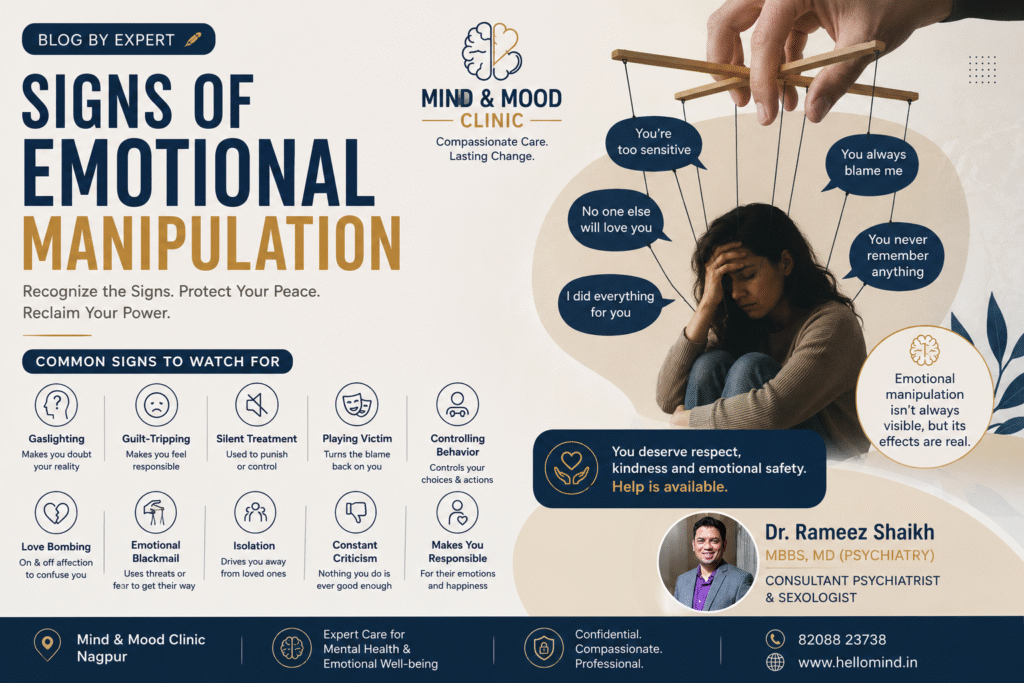
Common Signs of Emotional Manipulation
1. Gaslighting
Gaslighting makes you question your own memory or reality.
Example:
You clearly remember your partner shouting at you.
They respond:
“That never happened. You’re imagining things.”
Over time, you begin doubting your own memory.
2. Constant Guilt-Tripping
The manipulator makes you feel guilty for saying “no.”
Example:
“I’ve done everything for you, and this is how you repay me?”
Eventually, you agree just to avoid feeling guilty.
3. Silent Treatment
Instead of discussing problems, they stop talking to punish you.
Example:
After a disagreement, they ignore your calls and messages for several days until you apologize.
4. Playing the Victim
Even when they hurt you, they somehow become the victim.
Example:
When you express your feelings, they say:
“You’re always attacking me.”
The conversation shifts from your pain to comforting them.
5. Excessive Criticism
Nothing you do ever seems good enough.
Examples include:
- “You’re too sensitive.”
- “You’ll never succeed.”
- “Nobody else would tolerate you.”
Repeated criticism gradually damages self-esteem.
6. Love Bombing
At the beginning, they overwhelm you with affection, gifts, and promises.
Later, this affection suddenly disappears, leaving you constantly trying to “earn” their love again.
7. Emotional Blackmail
They threaten consequences if you don’t do what they want.
Example:
“If you really loved me, you’d quit your job.”
Or,
“If you leave me, I’ll harm myself.”
Such situations should always be taken seriously and addressed with professional help.
8. Isolation
Manipulators may slowly distance you from your family and friends.
Example:
“They don’t care about you.”
“You only need me.”
Over time, your support system becomes smaller.
9. Controlling Behaviour
They try to control:
- Your clothes
- Friends
- Money
- Social media
- Daily routine
- Career choices
Control is often disguised as “care.”
10. Making You Feel Responsible for Their Emotions
They expect you to fix every problem they experience.
You begin feeling responsible for keeping them happy all the time.
How Emotional Manipulation Affects Mental Health
Living in a manipulative relationship can lead to:
- Anxiety
- Depression
- Panic attacks
- Low self-esteem
- Chronic stress
- Emotional exhaustion
- Relationship anxiety
- Difficulty trusting others
- Sleep problems
- Symptoms of PTSD in severe cases
Many people start believing they are “the problem,” even when they are not.
Why Do People Stay in Manipulative Relationships?
Leaving isn’t always easy.
People may stay because of:
- Fear of being alone
- Financial dependence
- Children
- Hope that the person will change
- Emotional attachment
- Low self-confidence
- Trauma bonding
Understanding these factors is important—staying does not mean someone is weak.
How Can You Protect Yourself?
- Trust your feelings.
- Keep in touch with supportive friends and family.
- Set healthy boundaries.
- Stop apologizing for things you didn’t do.
- Write down incidents if you often doubt your memory.
- Seek professional guidance if you feel emotionally trapped.
How We Help at Mind & Mood Clinic
At Mind & Mood Clinic, Nagpur, we understand that emotional manipulation can have a profound impact on mental health.
Dr. Rameez Shaikh (MBBS, MD Psychiatry) provides confidential assessment and treatment for individuals experiencing:
- Emotional abuse
- Anxiety
- Depression
- Low self-esteem
- Relationship difficulties
- Trauma-related symptoms
- OCD and excessive self-doubt
Treatment may include:
- Cognitive Behaviour Therapy (CBT)
- Supportive Psychotherapy
- Couples Counselling (when appropriate)
- Stress Management
- Medication for anxiety or depression if clinically indicated
The goal is to help individuals regain confidence, establish healthy boundaries, and build emotionally fulfilling relationships.
Frequently Asked Questions
Is emotional manipulation the same as emotional abuse?
Not always. Emotional manipulation involves controlling behaviors, while emotional abuse is typically more persistent, severe, and harmful. Manipulation can become emotionally abusive when it is repeated and causes psychological harm.
Can emotional manipulation cause anxiety?
Yes. Chronic manipulation can contribute to anxiety, depression, panic attacks, and low self-esteem.
How do I know if I’m being gaslighted?
If you constantly question your own memory, apologize excessively, or rely on someone else to tell you what is “real,” gaslighting may be occurring.
Can therapy help?
Yes. Therapy can help you recognize unhealthy patterns, rebuild self-confidence, improve boundaries, and recover from the psychological effects of manipulation.
Conclusion
Emotional manipulation is often subtle, making it difficult to recognize until it has already affected your confidence, relationships, and mental health. Learning to identify the warning signs is the first step toward protecting yourself.
Healthy relationships are built on trust, respect, honesty, empathy, and open communication—not fear, guilt, or control.
If you or someone you know is struggling with the effects of emotional manipulation, seeking professional help can make a significant difference.
By Dr. Rameez Shaikh, MBBS, MD (Psychiatry)
Consultant Psychiatrist & Sexologist
Mind & Mood Clinic, Nagpur
Website: www.hellomind.in

Dr. Rameez Shaikh (MBBS, MD, MIPS) is a consultant Psychiatrist, Sexologist & Psychotherapist in Nagpur and works at Mind & Mood Clinic. He believes that science-based treatment, encompassing spiritual, physical, and mental health, will provide you with the long-lasting knowledge and tool to find happiness and wholeness again.
Dr. Rameez Shaikh, a dedicated psychiatrist , is a beacon of compassion and understanding in the realm of mental health. With a genuine passion for helping others, he combines his extensive knowledge and empathetic approach to create a supportive space for his patients.