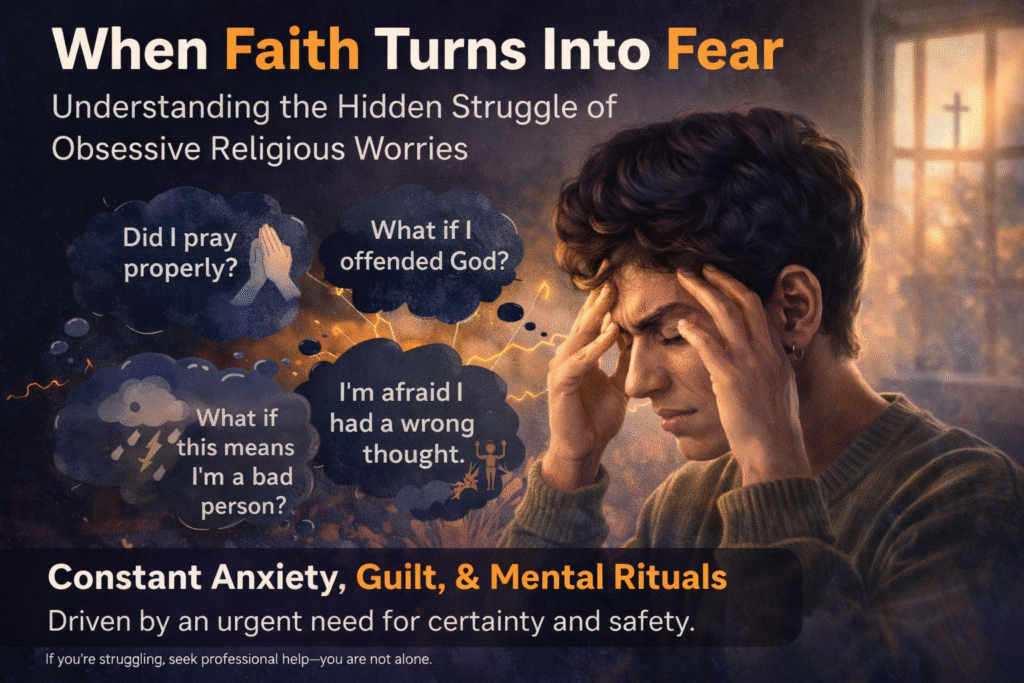
For many people, faith is a source of comfort.
It brings peace, meaning, and a sense of connection.
But for some… it slowly becomes something else.
Not peace.
Not comfort.
But fear, guilt, and constant mental noise.
And the most confusing part?
From the outside, it may look like strong devotion.
But on the inside, it feels like a battle that never stops.
“What If I Did Something Wrong?” – The Thought That Doesn’t Go Away
It usually starts very subtly.
A thought like:
- “What if I offended God?”
- “What if I didn’t pray properly?”
- “What if I had a bad or disrespectful thought?”
Most people would brush it off.
But here… the thought sticks.
It repeats.
It gets louder.
It demands attention.
And slowly, it turns into a loop:
👉 Thought → Anxiety → Attempt to fix → Temporary relief → Thought returns
The Invisible Compulsions
From the outside, nothing may look unusual.
But internally, the person is doing a lot to “neutralize” the anxiety:
- Repeating prayers again and again until it feels “just right”
- Mentally asking for forgiveness multiple times
- Avoiding certain thoughts, words, or situations
- Seeking reassurance: “I didn’t do anything wrong, right?”
- Trying to control every thought perfectly
This is not devotion.
This is distress trying to disguise itself as devotion.
The Difference No One Talks About
Here’s something important:
👉 Faith brings peace
👉 This pattern brings fear
👉 Faith feels chosen
👉 This feels forced
👉 Faith allows imperfection
👉 This demands absolute certainty
That difference is everything.
“But What If This Thought Means Something About Me?”
One of the most painful parts of this struggle is how personal it feels.
People often think:
- “Why am I having these thoughts?”
- “Does this mean I’m a bad person?”
- “What if I secretly believe this?”
But in reality, these thoughts are intrusive.
They are:
- Unwanted
- Distressing
- Not aligned with the person’s actual beliefs
In fact, the very reason they hurt so much is because
they go against what the person truly values.
Why This Happens (Simple Explanation)
The mind tries to protect you.
But sometimes, it overdoes it.
It treats thoughts like threats.
And then tries to “fix” them.
But the more you try to control thoughts…
the stronger they become.
It’s like trying not to think of something—
and ending up thinking about it even more.
The Trap of “Just One More Time”
Many people tell themselves:
- “Let me just repeat this one more time to be sure.”
- “Let me just pray again properly.”
And it works—for a moment.
But then the doubt returns.
And the cycle continues.
This is how the mind gets stuck.
The Emotional Impact
Over time, this can lead to:
- Constant anxiety
- Guilt that doesn’t match reality
- Mental exhaustion
- Avoidance of spiritual practices
- Feeling disconnected from one’s own faith
And perhaps the most painful part:
Feeling alone in something no one else seems to understand.
Healing Begins With One Realization
The turning point is this:
“This is not about my faith.
This is about how my mind is reacting to thoughts.”
That shift changes everything.
Because now, the focus is not on “fixing yourself”…
but on understanding your mind.
What Actually Helps
Recovery is not about stopping thoughts.
It’s about changing your relationship with them.
That includes:
- Allowing thoughts to exist without reacting
- Reducing repetitive mental rituals
- Learning to tolerate uncertainty
- Gradually facing feared situations without “fixing” them
And most importantly:
Learning that thoughts are not facts.
A Personal Reflection
Many of the people I’ve worked with are deeply sincere.
They care about doing the right thing.
They value morality, faith, and meaning.
And that’s exactly why this struggle hits them so hard.
Because when something matters deeply—
the mind tries even harder to control it.
Final Thought
If you’ve ever felt like your mind won’t let you rest…
like you’re constantly trying to “get it right”…
like peace always feels just out of reach—
You’re not alone.
And more importantly:
This is treatable.
Not by forcing yourself to be perfect…
but by learning that you don’t need to be.
Because true faith—
and true peace—
Doesn’t come from fear.
It comes from freedom.
Disclaimer
This article is for awareness purposes only and does not substitute professional mental health advice. If you are struggling with distressing thoughts or anxiety, please consult a qualified psychiatrist or mental health professional.
Dr. Rameez Shaikh, MD
Psychiatrist & Counsellor
Mind & Mood Clinic
🌐 www.hellomind.in
📞 +91-8208823738

Dr. Rameez Shaikh (MBBS, MD, MIPS) is a consultant Psychiatrist, Sexologist & Psychotherapist in Nagpur and works at Mind & Mood Clinic. He believes that science-based treatment, encompassing spiritual, physical, and mental health, will provide you with the long-lasting knowledge and tool to find happiness and wholeness again.
Dr. Rameez Shaikh, a dedicated psychiatrist , is a beacon of compassion and understanding in the realm of mental health. With a genuine passion for helping others, he combines his extensive knowledge and empathetic approach to create a supportive space for his patients.