Introduction
Every parent wants to see their child laughing with friends, enjoying school, and feeling accepted. But what if your child spends every recess alone, avoids birthday parties, or says, “Nobody wants to play with me.”
Many parents assume their child is simply “shy” and will grow out of it. While some children naturally take longer to warm up socially, persistent difficulty making or keeping friends may be an early sign of emotional, behavioural, developmental, or communication challenges.
As a psychiatrist, I often meet parents who seek help only after years of loneliness, bullying, falling academic performance, or emotional distress. Early identification and intervention can make a significant difference.
Why Friendships Matter
Friendships are more than play—they help children develop:
- Communication skills
- Emotional regulation
- Empathy
- Problem-solving
- Teamwork
- Confidence
- Resilience
- Conflict resolution
Children with healthy friendships often experience better emotional well-being, higher self-esteem, and improved academic performance.
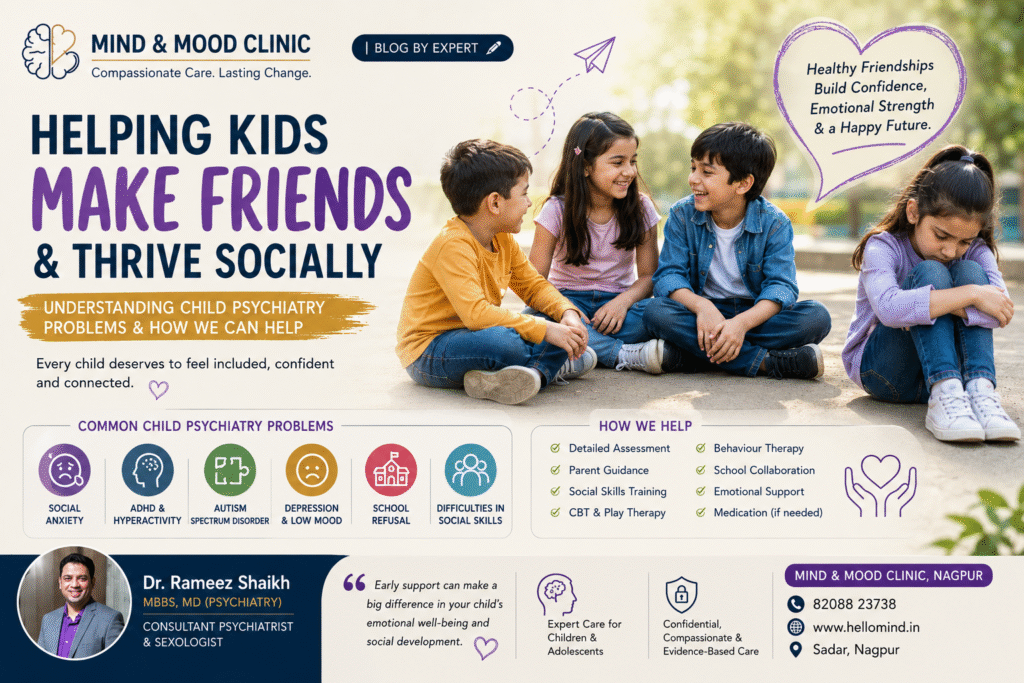
Common Child Psychiatry Problems That Affect Friendships
1. Social Anxiety Disorder
Children with social anxiety fear being judged, embarrassed, or rejected.
Signs
- Avoids speaking in class
- Refuses birthday parties
- Hides behind parents
- Doesn’t initiate conversations
- Worries excessively before school
Example
An 8-year-old wants friends but never joins games because he fears others will laugh at him.
2. ADHD (Attention-Deficit/Hyperactivity Disorder)
Children with ADHD often struggle with impulsivity and attention.
They may:
- Interrupt conversations
- Not wait their turn
- Become impatient
- Misread social cues
- Have frequent arguments
Although they usually want friends, maintaining friendships can be difficult.
3. Autism Spectrum Disorder (ASD)
Children with autism may experience challenges understanding social communication.
They may:
- Prefer playing alone
- Miss facial expressions
- Avoid eye contact
- Talk only about favourite interests
- Find group play confusing
With support, many children develop meaningful friendships.
4. Depression
Depression in children doesn’t always look like sadness.
It may appear as:
- Irritability
- Loss of interest
- Social withdrawal
- Low energy
- Avoiding friends
5. Bullying
Bullying can make children fearful of interacting with peers.
Warning signs include:
- School refusal
- Frequent stomach aches
- Crying before school
- Loss of confidence
- Declining grades
6. Learning Disorders
Children with dyslexia or other learning disorders may feel embarrassed in class and avoid social situations because of fear of being teased.
7. Emotional Regulation Difficulties
Children who have frequent anger outbursts, frustration, or poor impulse control may unintentionally push peers away.
Signs Your Child May Need Extra Support
Consider professional evaluation if your child:
- Has no close friends despite wanting them
- Avoids school or group activities
- Is frequently bullied
- Cries after social interactions
- Becomes anxious around peers
- Has frequent conflicts with classmates
- Prefers isolation most of the time
- Shows sudden changes in behaviour
How Parents Can Help Children Make Friends
Encourage Small Social Opportunities
Instead of large parties, begin with one-on-one playdates where your child feels comfortable.
Teach Conversation Skills
Practice:
- Greeting others
- Asking questions
- Sharing toys
- Taking turns
- Listening without interrupting
Role-playing at home helps children feel more confident.
Praise Effort, Not Popularity
Celebrate small achievements like:
- Saying hello
- Joining a game
- Introducing themselves
- Inviting someone to play
Confidence grows through repeated positive experiences.
Limit Excessive Screen Time
Too much screen time can reduce opportunities to practice real-life communication and emotional skills.
Encourage outdoor play, sports, art classes, music, or hobby groups.
Help Children Understand Emotions
Teach them to identify feelings such as:
- Happy
- Sad
- Angry
- Nervous
- Frustrated
- Excited
Emotionally aware children often communicate better with peers.
Model Healthy Friendships
Children learn by observing adults.
Show kindness, respect, empathy, and healthy conflict resolution in your own relationships.
What Parents Should Avoid
Avoid saying:
- “Just make friends.”
- “Stop being shy.”
- “Why can’t you be like your sister?”
- “You’re too sensitive.”
Instead say:
- “I know making friends can feel difficult.”
- “Let’s practice together.”
- “I’m proud of you for trying.”
Supportive language builds confidence.
How a Psychiatrist Can Help
Many parents believe psychiatrists only prescribe medication.
In reality, child psychiatry focuses on understanding the child’s emotional, behavioural, developmental, family, and school environment.
At Mind & Mood Clinic, evaluation includes:
- Developmental history
- School behaviour
- Social skills assessment
- Emotional functioning
- Attention and learning concerns
- Family dynamics
- Anxiety and mood screening
Treatment is individualized and may include:
Parent Guidance
Helping parents respond effectively to behavioural and emotional challenges.
Cognitive Behaviour Therapy (CBT)
Helping children develop healthier thoughts and coping strategies.
Social Skills Training
Teaching children how to:
- Start conversations
- Maintain friendships
- Understand body language
- Handle teasing
- Resolve conflicts
Behaviour Therapy
Improving emotional regulation, attention, and impulse control.
School Collaboration
Working with teachers to create supportive classroom strategies.
Medication
Medication is considered only when clinically indicated, such as moderate to severe ADHD, anxiety disorders, depression, or other psychiatric conditions, and is always part of a comprehensive treatment plan—not a substitute for therapy and family support.
A Real-Life Example (Fictional)
Rohan, a 9-year-old boy, rarely spoke in class and spent every lunch break alone. His parents thought he was simply shy. During assessment, he was found to have significant social anxiety.
With CBT, gradual exposure, parent coaching, and collaboration with his school, Rohan slowly began greeting classmates, participating in group activities, and eventually developed close friendships.
Early intervention transformed not only his social life but also his confidence and academic performance.
When Should You Seek Professional Help?
Consult a child psychiatrist if your child:
- Has persistent difficulty making friends
- Experiences severe anxiety around peers
- Shows developmental concerns
- Is frequently bullied
- Has emotional or behavioural outbursts
- Avoids school
- Appears lonely or withdrawn
- Shows symptoms of ADHD or autism
- Experiences depression or significant mood changes
Conclusion
Every child develops social skills at their own pace. However, persistent loneliness, fear of social interaction, or difficulty making friends should not be ignored.
With understanding, early intervention, supportive parenting, and professional guidance, children can learn the skills they need to build meaningful friendships and thrive emotionally.
At Mind & Mood Clinic, Nagpur, Dr. Rameez Shaikh (MBBS, MD Psychiatry) provides compassionate, evidence-based care for children and adolescents facing emotional, behavioural, and developmental challenges. Our goal is to help every child build confidence, develop healthy relationships, and reach their full potential.
Frequently Asked Questions (FAQ)
Is it normal for my child to have only one friend?
Yes. Many children are happy with one or two close friendships. Concern arises when a child wants friends but consistently struggles to make or keep them.
Can ADHD make it difficult for children to make friends?
Yes. Impulsivity, inattention, and difficulty reading social cues can affect friendships, but appropriate treatment and social skills training can help.
Does every shy child need therapy?
No. Shyness is a personality trait. Therapy is recommended when anxiety or social difficulties significantly interfere with school, friendships, or daily functioning.
Can social skills be taught?
Absolutely. Social skills improve through practice, modelling, therapy, and positive experiences.
By Dr. Rameez Shaikh, MBBS, MD (Psychiatry)
Consultant Psychiatrist | Child & Adolescent Mental Health
Mind & Mood Clinic, Nagpur
Website: www.hellomind.in

Dr. Rameez Shaikh (MBBS, MD, MIPS) is a consultant Psychiatrist, Sexologist & Psychotherapist in Nagpur and works at Mind & Mood Clinic. He believes that science-based treatment, encompassing spiritual, physical, and mental health, will provide you with the long-lasting knowledge and tool to find happiness and wholeness again.
Dr. Rameez Shaikh, a dedicated psychiatrist , is a beacon of compassion and understanding in the realm of mental health. With a genuine passion for helping others, he combines his extensive knowledge and empathetic approach to create a supportive space for his patients.