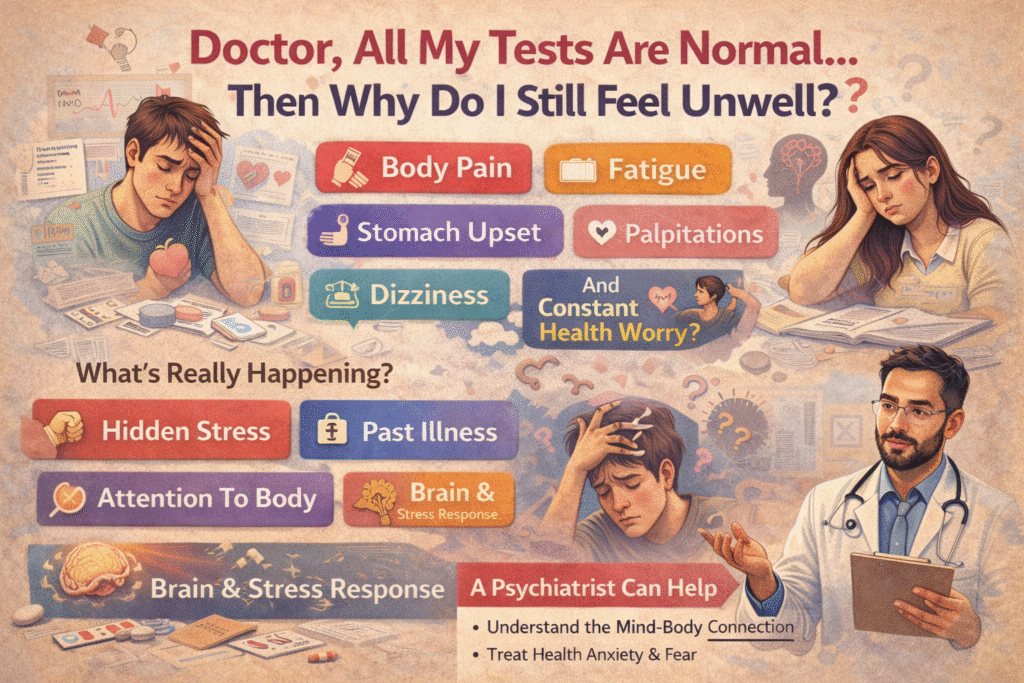
In my clinic, some of the most distressed patients say this with genuine fear and frustration:
“My body keeps troubling me, but doctors say nothing is wrong.”
They are not pretending.
They are not imagining things.
And they are certainly not “seeking attention.”
Their suffering is real, even when scans and reports are normal.
This blog is about that experience—without using diagnostic labels—so it can be understood without stigma.
What These Patients Commonly Experience
The symptoms are physical. The distress is intense.
Common Bodily Complaints
- Persistent body pain (head, back, joints, chest)
- Stomach discomfort, bloating, nausea
- Palpitations or breathlessness
- Fatigue that doesn’t improve with rest
- Dizziness, weakness, heaviness
- Sensations that “something is seriously wrong”
Often, the symptoms:
- Keep changing
- Shift from one body part to another
- Worsen during stress or emotional conflict
The Key Feature: Constant Health Worry
What differentiates this condition is not just symptoms—but how much the mind gets stuck on them.
Patients often:
- Frequently check their body
- Google symptoms repeatedly
- Visit multiple doctors
- Fear serious illness despite reassurance
- Feel temporarily relieved after tests—then anxious again
This cycle is exhausting.
Real-Life Example
A 34-year-old working professional experiences chest tightness and palpitations.
- ECG, echo, blood tests → normal
- Still feels something is “missed”
- Avoids exercise out of fear
- Repeatedly checks pulse
- Anxiety increases → symptoms worsen
The body becomes a constant source of threat.
Why Does This Happen? (Etiology – The “Why”)
This condition does not start from imagination. It develops due to multiple interacting factors.
1. Stress That Never Got Expressed
Many patients:
- Suppress emotions
- Avoid conflict
- “Keep going” despite inner distress
The body becomes the only outlet for unexpressed emotional tension.
2. Past Illness or Trauma
- Serious illness in the past
- Witnessing illness or death of a loved one
- Childhood experiences of frequent medical attention
The brain learns:
“Body sensations = danger”
3. High Sensitivity to Body Signals
Some people naturally notice body sensations more intensely.
A normal heartbeat becomes alarming.
Normal fatigue feels pathological.
4. Anxiety-Prone Personality
People who are:
- Perfectionistic
- Highly responsible
- Fearful of uncertainty
are more vulnerable.
What Is Happening Inside the Brain? (Pathogenesis – The “How”)
This is where psychiatry becomes important.
1. Brain–Body Miscommunication
The brain’s threat system (amygdala) stays overactive.
Normal sensations are misinterpreted as danger.
2. Stress Hormones Amplify Sensations
Chronic stress increases:
- Muscle tension
- Gut sensitivity
- Heart rate variability
The body genuinely feels uncomfortable.
3. Attention Fuels Symptoms
The more attention given to symptoms:
- The stronger they feel
- The longer they last
This is not voluntary—it’s neurobiological.
4. Reassurance Doesn’t Last
Because the problem is not structural, tests don’t fix it.
Temporary relief → anxiety returns → symptoms recur.
Why Patients Feel Invalidated
Many are told:
- “Nothing is wrong”
- “It’s all in your head”
- “Stop thinking too much”
This increases:
- Shame
- Helplessness
- Doctor shopping
What they actually need is explanation, not dismissal.
How a Psychiatrist Helps
Psychiatric care does not mean “you’re imagining it.”
It means:
“Your brain and body are stuck in a stress loop—and we know how to treat that.”
A psychiatrist helps by:
1. Making Sense of Symptoms
Explaining why symptoms are real even when tests are normal reduces fear dramatically.
Understanding itself is therapeutic.
2. Reducing Fear Response
Treatment targets:
- Health anxiety
- Hypervigilance to body sensations
- Catastrophic thinking
When fear reduces, symptoms soften.
3. Treating Underlying Anxiety or Depression
Many patients have:
- Hidden anxiety
- Chronic stress
- Mild depression
Addressing this improves physical symptoms.
4. Medication (Only If Needed)
Used carefully to:
- Calm the brain’s threat system
- Reduce bodily sensitivity
- Improve sleep and energy
Not everyone needs medication—but for some, it is life-changing.
5. Helping Patients Stop the Cycle
Gradual reduction of:
- Excessive checking
- Repeated investigations
- Health-related reassurance seeking
This restores normal functioning.
An Important Truth
These patients are not weak.
They are often among the most responsible, hardworking, and emotionally contained people.
Their body speaks because their emotions were never allowed to.
When Should You Seek Psychiatric Help?
- Symptoms persist despite normal medical tests
- Health worry dominates daily life
- Multiple doctor visits without relief
- Fear of serious illness does not go away
- Quality of life is affected
Early help prevents years of unnecessary suffering.
Final Words
Physical suffering without medical explanation is not imaginary suffering.
It is a real brain–body condition.
And it is treatable.
Understanding replaces fear.
Treatment restores control.
Life becomes livable again.
(This blog is for educational purposes and does not replace professional consultation.)

Dr. Rameez Shaikh (MBBS, MD, MIPS) is a consultant Psychiatrist, Sexologist & Psychotherapist in Nagpur and works at Mind & Mood Clinic. He believes that science-based treatment, encompassing spiritual, physical, and mental health, will provide you with the long-lasting knowledge and tool to find happiness and wholeness again.
Dr. Rameez Shaikh, a dedicated psychiatrist , is a beacon of compassion and understanding in the realm of mental health. With a genuine passion for helping others, he combines his extensive knowledge and empathetic approach to create a supportive space for his patients.