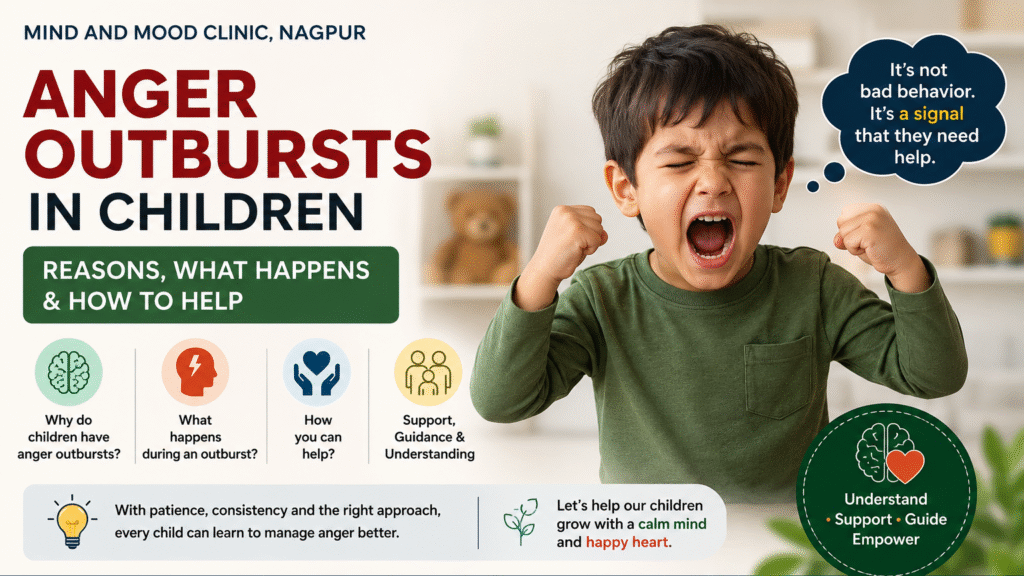
As parents, one of the most distressing experiences is seeing your child suddenly scream, throw things, or lose control over small issues. Many families come to the clinic saying, “Doctor, my child gets angry over very small things… what is happening?”
Let’s understand this in a simple, practical way.
What is an Anger Outburst in Children?

An anger outburst (also called a tantrum or meltdown) is a sudden, intense expression of anger. It may include:
- Crying, screaming, shouting
- Throwing objects
- Hitting or biting
- Refusing to listen or cooperate
- Saying hurtful things
This is not always “bad behavior.” Often, it is a sign that the child is overwhelmed and unable to express emotions properly.
Why Do Children Have Anger Outbursts?
1. Immature Emotional Regulation
Children, especially under 10 years, have not fully developed the ability to manage emotions. Their brain (especially the prefrontal cortex) is still developing.
👉 They feel strongly but don’t know how to control it.
2. Frustration and Unmet Needs
Common triggers include:
- Hunger, tiredness
- Not getting what they want
- Difficulty in studies
- Feeling misunderstood
A child who cannot express frustration verbally may express it through anger.
3. Attention-Seeking Behavior
Sometimes, children learn that anger gets attention.
Even negative attention (scolding, shouting) can reinforce the behavior.
4. Modeling from Environment
Children copy what they see.
If parents or family members frequently:
- Shout
- Argue
- React aggressively
The child may learn that anger is a normal response.
5. Underlying Psychological Issues
Frequent or severe outbursts may be linked to:
- ADHD
- Anxiety disorders
- Depression in children
- Oppositional Defiant Disorder (ODD)
6. Screen Overuse
Excessive mobile or gaming use can:
- Reduce frustration tolerance
- Increase irritability
- Affect sleep
What Happens During an Anger Outburst?
During an outburst:
- The “emotional brain” (amygdala) takes over
- The “thinking brain” temporarily shuts down
- The child cannot listen to logic
👉 This is why reasoning or scolding in that moment often fails.
How to Help a Child with Anger Outbursts
1. Stay Calm (Most Important)
Your reaction determines the outcome.
❌ If you shout → child escalates
✅ If you stay calm → child settles faster
2. Don’t Try to Reason Immediately
During the outburst:
- Avoid lectures
- Avoid long explanations
Wait until the child calms down.
3. Validate Feelings
Say:
- “I understand you are angry”
- “It’s okay to feel upset”
This reduces emotional intensity.
4. Set Clear Boundaries
Validation does NOT mean allowing bad behavior.
Say calmly:
- “I understand you are angry, but hitting is not allowed.”
5. Teach Emotional Expression
Help children name emotions:
- Angry
- Sad
- Frustrated
Encourage:
- Talking
- Drawing
- Writing feelings
6. Create Routine and Structure
Children feel safer when life is predictable:
- Fixed sleep time
- Fixed study/play time
- Limited screen time
7. Positive Reinforcement
Reward calm behavior:
- Praise
- Small rewards
- Appreciation
Children repeat what gets attention.
8. Reduce Triggers
Observe patterns:
- Does anger happen during homework?
- After screen time?
- When tired?
Modify the situation accordingly.
9. Teach Calm-Down Techniques
Simple methods:
- Deep breathing (5 slow breaths)
- Counting 1 to 10
- Taking a break
Practice when the child is calm, not during anger.
10. Seek Professional Help When Needed
Consult a psychiatrist or child psychologist if:
- Outbursts are very frequent
- Child becomes violent
- School complaints are increasing
- Behavior affects daily functioning
Early intervention prevents long-term issues.
A Practical Example
A 7-year-old child throws things when asked to study.
❌ Parent reaction: shouting → child cries louder
✅ Better approach:
- Stay calm
- Say: “I know you don’t feel like studying”
- Give a small break
- Restart with short tasks
Gradually, the child learns control.
Final Thoughts
Anger in children is not always a problem—it is a signal.
👉 A signal that the child needs help, understanding, and guidance.
With patience, consistency, and the right approach, most children improve significantly.
Disclaimer
This article is for educational purposes only. If your child’s anger is severe, persistent, or affecting daily life, please consult a qualified mental health professional for proper evaluation and treatment.
About the clinic
This blog is written for Mind and Mood Clinic by Dr. Rameez Shaikh

Dr. Rameez Shaikh (MBBS, MD, MIPS) is a consultant Psychiatrist, Sexologist & Psychotherapist in Nagpur and works at Mind & Mood Clinic. He believes that science-based treatment, encompassing spiritual, physical, and mental health, will provide you with the long-lasting knowledge and tool to find happiness and wholeness again.
Dr. Rameez Shaikh, a dedicated psychiatrist , is a beacon of compassion and understanding in the realm of mental health. With a genuine passion for helping others, he combines his extensive knowledge and empathetic approach to create a supportive space for his patients.