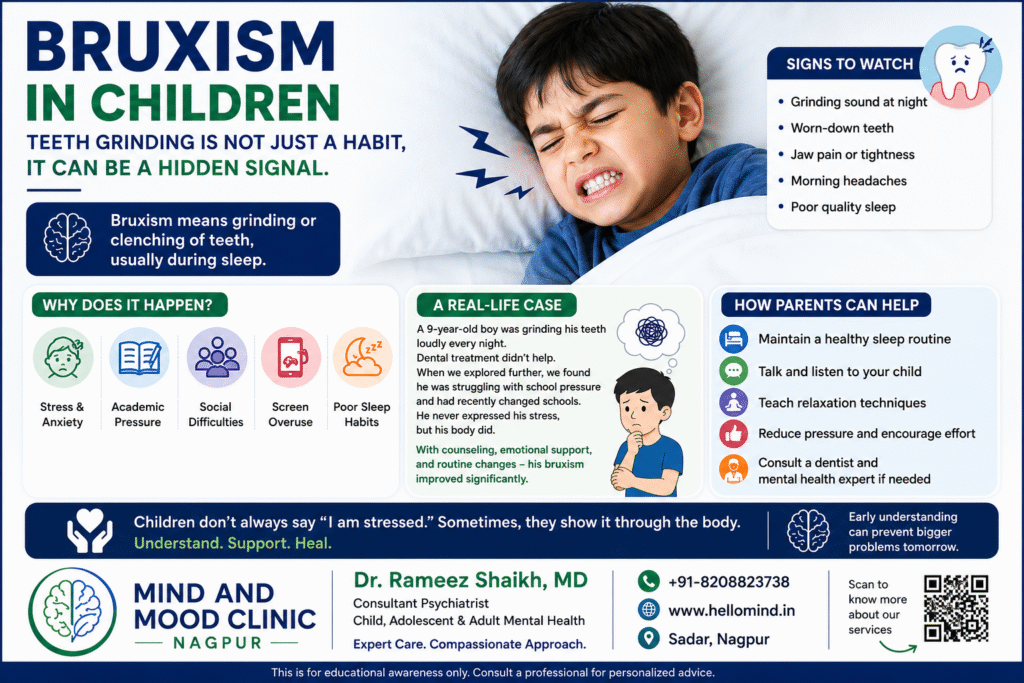
Many parents come with a common concern:
“Doctor, my child grinds teeth at night… is it serious?”
This condition is called bruxism—and while it may seem harmless, sometimes it tells us something deeper about a child’s mind.
What is Bruxism?
Bruxism means grinding or clenching of teeth, usually during sleep.
It can happen:
- At night (most common)
- During the day (less common)
You may notice:
- Grinding sounds while the child sleeps
- Worn-down teeth
- Jaw tightness
- Complaints of headache in the morning
A Real-Life Case (From My Practice)
A 9-year-old boy was brought to the clinic by his parents.
The mother said:
“Doctor, every night we hear a loud grinding sound… we are scared his teeth will break.”
They had already consulted a dentist, who suggested a mouth guard. But the problem continued.
When I spoke to the child, he was quiet. On gentle questioning, he shared something important:
👉 He had recently changed schools.
👉 He was struggling to make friends.
👉 He was anxious about studies and felt “not good enough.”
He never expressed this openly—but his body did.
The teeth grinding was not just a dental issue—it was stress coming out during sleep.
With counseling, emotional support, and simple routine changes, his bruxism reduced significantly over the next few weeks.
Why Does Bruxism Happen in Children?
1. Stress and Anxiety (Most Common Cause)
Children may not say “I am stressed”… but their body shows it.
Triggers include:
- School pressure
- Fear of failure
- Social difficulties
- Family conflicts
2. Emotional Suppression
Some children:
- Don’t express anger
- Try to “be perfect”
- Keep feelings inside
This internal tension can show up as grinding.
3. Sleep Problems
- Irregular sleep schedule
- Poor sleep quality
- Night awakenings
4. Dental Factors
- Misaligned teeth
- Bite problems
5. Hyperactivity or ADHD

Children with high energy or impulsivity may have increased risk.
6. Screen Overuse
Late-night mobile use:
- Disturbs sleep
- Increases brain stimulation
- Reduces relaxation
What Happens If It Is Ignored?
Mild bruxism may go away on its own. But persistent cases can lead to:
- Tooth damage or sensitivity
- Jaw pain
- Headaches
- Poor sleep quality
- Increased irritability
How to Help Your Child
1. Don’t Panic
Most cases are manageable and reversible.
2. Improve Sleep Routine
- Fixed sleep time
- No screens 1 hour before bed
- Calm bedtime environment
3. Talk to Your Child
Instead of asking:
❌ “Why are you doing this?”
Try:
✅ “Is something bothering you?”
✅ “How was your day?”
4. Reduce Pressure
Avoid:
- Constant comparison
- Unrealistic expectations
Encourage effort, not perfection.
5. Teach Relaxation
Simple techniques:
- Deep breathing
- Bedtime storytelling
- Light music
6. Dental Consultation
If needed:
- Mouth guards
- Dental correction
7. Seek Professional Help
Consult a mental health expert if:
- Grinding is severe
- Child is anxious or withdrawn
- Sleep is disturbed
- Behavior changes are noticed
A Simple Insight for Parents
👉 Children don’t always say “I am stressed.”
👉 Sometimes, they show it through the body.
Bruxism is one such silent signal.
Final Thoughts
Don’t ignore it. Don’t overreact.
Understand it.
With the right balance of emotional support, routine, and guidance, most children recover well.
Contact Information
📍 Mind and Mood Clinic, Nagpur
👨⚕️ Dr. Rameez Shaikh, MD
📞 +91-8208823738
🌐 www.hellomind.in
Disclaimer
This article is for educational purposes only. If your child has persistent symptoms, consult a qualified professional for proper diagnosis and treatment.

Dr. Rameez Shaikh (MBBS, MD, MIPS) is a consultant Psychiatrist, Sexologist & Psychotherapist in Nagpur and works at Mind & Mood Clinic. He believes that science-based treatment, encompassing spiritual, physical, and mental health, will provide you with the long-lasting knowledge and tool to find happiness and wholeness again.
Dr. Rameez Shaikh, a dedicated psychiatrist , is a beacon of compassion and understanding in the realm of mental health. With a genuine passion for helping others, he combines his extensive knowledge and empathetic approach to create a supportive space for his patients.