Every day in clinic, I hear some version of this:
- “I just watch for 10 minutes.”
- “It helps me relax.”
- “I scroll before sleeping.”
- “I don’t know why I feel anxious after Instagram.”
Social media platforms like YouTube Shorts and Instagram are not accidental habits.
They are engineered attention systems.
And the effect on emotional well-being is deeper than most people realize.
How YouTube Shorts & Instagram Affect Emotional Well-Being
Short-form content is designed to:
- Deliver fast emotional stimulation
- Trigger surprise, humor, shock, or validation
- Keep attention moving without pause
This constant stimulation changes how the brain processes:
- Reward
- Focus
- Comparison
- Self-worth
Over time, it can increase:
- Social media anxiety
- Low mood
- Irritability
- Sleep disturbances
- Reduced concentration
The Psychology Behind Social Media Addiction
This is not about weak willpower.
It is about dopamine-based reinforcement loops.
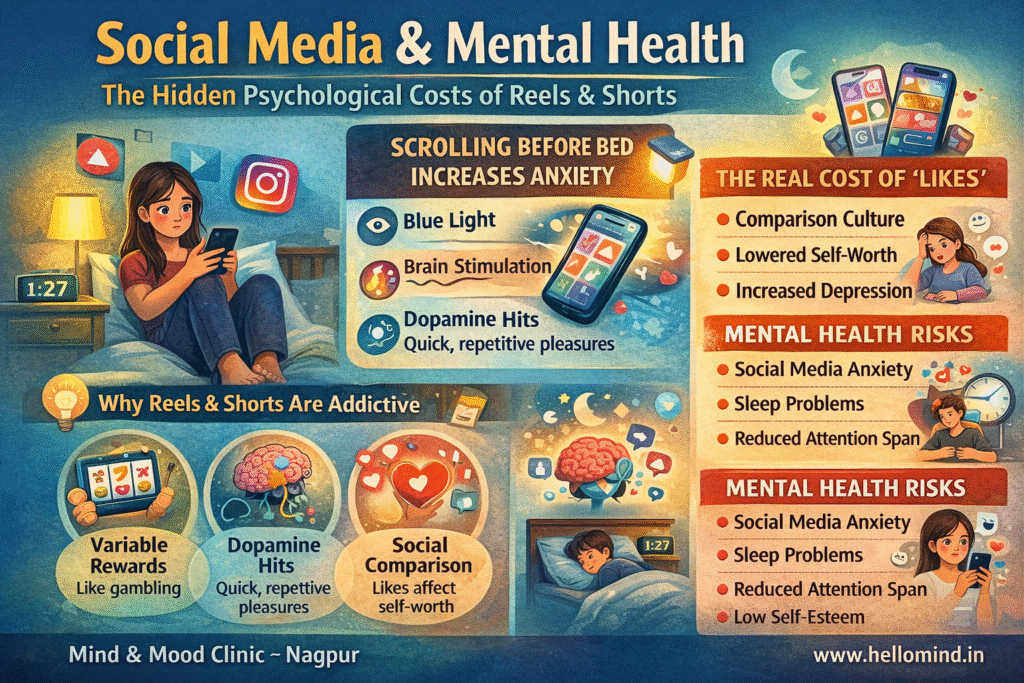
1. Variable Reward System (Same as Gambling)
You don’t know what the next reel will be.
- Sometimes funny
- Sometimes inspiring
- Sometimes shocking
That unpredictability creates a dopamine spike.
The brain learns:
“Scroll again. Maybe something better is coming.”
This is called a variable reward schedule — the most addictive reinforcement pattern known in behavioral psychology.
2. Micro-Dopamine Hits
Each like, comment, or new reel gives a tiny reward.
Not satisfaction.
Just stimulation.
Over time:
- Baseline dopamine sensitivity decreases
- Real-life activities feel boring
- Attention span reduces
The brain starts craving short bursts of novelty.
3. Social Validation Loop
When someone posts a reel or photo:
- Brain anticipates likes
- Checks repeatedly
- Anxiety rises if response is low
- Relief when validation appears
This creates psychological dependence.
You are no longer using the app.
You are waiting for it to approve you.
Social Comparison & Self-Worth: The Real Cost of “Likes”
Instagram rarely shows:
- Ordinary days
- Failures
- Financial struggles
- Emotional breakdowns
It shows curated success.
The brain automatically compares:
“Why is everyone happier?”
“Why am I behind?”
“Why don’t I look like that?”
This leads to:
- Instagram self-esteem issues
- Body image dissatisfaction
- Performance anxiety
- Social media depression
Research consistently links heavy social media use with increased depressive symptoms, especially in adolescents and young adults.
Why Scrolling Before Bed Increases Anxiety and Sleep Problems
Scrolling at night does three harmful things:
1. Blue Light Disrupts Melatonin
Melatonin regulates sleep.
Screen light delays sleep onset.
2. Emotional Overstimulation
Before sleep, the brain needs calm.
Instead, it receives:
- Emotional reels
- News
- Comparison triggers
- Fast transitions
The nervous system remains activated.
3. Cognitive Overload
Short videos train the brain to expect rapid novelty.
When you try to sleep:
- Mind keeps replaying
- Thoughts feel restless
- Anxiety increases
This leads to:
- Delayed sleep
- Light, poor-quality sleep
- Morning fatigue
Chronic sleep disruption worsens anxiety and depression.
Are Funny Reels and Sending Videos to Friends Harmless?
It depends.
Occasional sharing:
- Strengthens social bonding
- Creates laughter
- Reduces stress
But repetitive sending and consuming becomes:
- A loop of stimulation
- Avoidance of boredom
- Avoidance of uncomfortable emotions
Ask yourself:
Are you sharing to connect?
Or scrolling to escape?
There is a psychological difference.
How Dependence Develops
Step 1: You use it for relaxation
Step 2: It becomes your primary stress tool
Step 3: Boredom feels intolerable without it
Step 4: Mood dips when not scrolling
Step 5: Productivity reduces
Step 6: Anxiety increases
Now it is no longer casual use.
It is emotional regulation through digital stimulation.
Signs You May Be Developing Social Media Dependence
- Checking phone first thing in morning
- Scrolling before sleep daily
- Irritability when phone unavailable
- Reduced focus on studies/work
- Feeling low after scrolling
- Comparing yourself constantly
Social Media Anxiety & Depression
Heavy users often report:
- Fear of missing out (FOMO)
- Fear of being judged
- Pressure to post
- Anxiety about replies
- Decreased offline social confidence
Long-term emotional consequences may include:
- Social withdrawal
- Low motivation
- Increased rumination
- Identity confusion
What Can Be Done?
1. Set Screen Boundaries
- No scrolling 60 minutes before sleep
- Keep phone outside bedroom
- Fixed usage windows
2. Replace Micro-Dopamine with Deep Reward
Instead of reels:
- Exercise
- Reading
- Music
- Face-to-face conversations
Deep reward stabilizes mood.
3. Mindful Consumption
Before opening the app, ask:
“Why am I opening this?”
If answer is:
“I’m bored” or “I feel uncomfortable”
Then it’s avoidance.
4. Seek Help If Needed
If social media use is causing:
- Social media anxiety
- Depressive symptoms
- Sleep problems
- Reduced academic/work performance
Professional guidance can help.
Psychiatric treatment may include:
- Behavioral interventions
- CBT for social comparison
- Anxiety management
- Sleep regulation
- Medication if clinically indicated
Final Thought
Social media is not evil.
But it is powerful.
Used consciously, it connects.
Used unconsciously, it consumes.
Your attention is valuable.
Your self-worth is not measured in likes.
And your brain deserves rest.

Dr. Rameez Shaikh (MBBS, MD, MIPS) is a consultant Psychiatrist, Sexologist & Psychotherapist in Nagpur and works at Mind & Mood Clinic. He believes that science-based treatment, encompassing spiritual, physical, and mental health, will provide you with the long-lasting knowledge and tool to find happiness and wholeness again.
Dr. Rameez Shaikh, a dedicated psychiatrist , is a beacon of compassion and understanding in the realm of mental health. With a genuine passion for helping others, he combines his extensive knowledge and empathetic approach to create a supportive space for his patients.