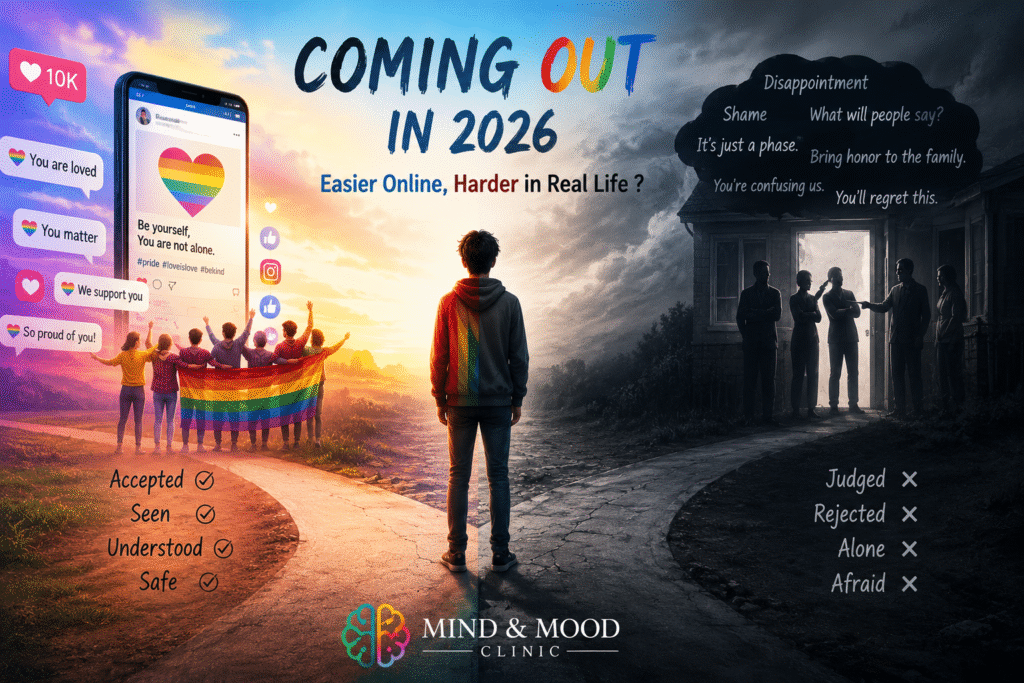
In 2026, the internet often makes it look like the world has become completely accepting of LGBTQ identities.
Open Instagram.
You will see pride flags, supportive influencers, gender-neutral language, coming-out videos with millions of likes, and comments saying:
“Be yourself.”
“We support you.”
“You deserve love.”
Online, acceptance can sometimes feel immediate.
But for many people living in conservative families, small towns, traditional communities, or emotionally rigid households — reality still feels very different.
Because while the internet may clap for someone’s identity…
real life may still punish it.
And this emotional gap between “digital acceptance” and “real-world experience” has become one of the biggest hidden psychological struggles among LGBTQ individuals today.
The Internet Created Visibility — But Not Equal Safety
Social media has undeniably changed lives.
For many LGBTQ individuals, the internet became:
- the first safe space
- the first source of education
- the first place they saw people like themselves
- the first place they realized:
“I am not alone.”
For someone growing up in a conservative environment, watching another person openly discuss:
- gender dysphoria
- same-sex attraction
- transition
- pronouns
- identity struggles
can feel emotionally life-changing.
Many people finally found language for feelings they had silently carried for years.
And emotionally, that matters.
But Real Life Often Moves Slower Than The Internet
The problem is this:
Social media evolves faster than families.
A teenager may spend years online in accepting digital spaces…
then walk into a home where:
- homosexuality is mocked
- gender identity is dismissed
- masculinity/femininity is heavily controlled
- mental health is stigmatized
- reputation matters more than emotional well-being
And suddenly the person begins living two completely different lives.
Online:
They feel understood.
Offline:
They feel unsafe.
The Double Life Many LGBTQ Individuals Live
Many people in conservative communities become experts at emotional hiding.
Some maintain:
- secret social media accounts
- separate friend circles
- hidden relationships
- different clothing styles outside home
- hidden therapy sessions
- hidden hormone use
- emotional masking
They may smile during family gatherings while internally carrying constant fear:
“What if someone finds out?”
Living this double life can become mentally exhausting.
Why Coming Out Is Still Emotionally Difficult
Online culture sometimes unintentionally oversimplifies coming out.
Videos often show:
- dramatic reveals
- supportive parents
- emotional hugs
- instant acceptance
But many people fear:
- rejection
- emotional abuse
- forced marriage
- financial cutoff
- violence
- social humiliation
- religious condemnation
- losing family support
- losing housing or education support
For some individuals, coming out is not just emotional.
It may involve real risks to safety and survival.
This is especially true in conservative cultural environments where identity is deeply tied to:
- family honor
- marriage expectations
- gender roles
- community reputation
“But Everyone Online Supports It…”
This sentence itself creates another hidden problem.
Some LGBTQ individuals begin feeling guilty or confused because:
“If society is becoming accepting, why am I still so scared?”
But acceptance is not equally distributed.
Urban online culture and real-world local culture can feel like two different worlds entirely.
Someone in a progressive online space may receive validation daily…
while still hearing anti-LGBTQ comments at home every night.
Both realities can exist simultaneously.
The Mental Health Impact
Living between acceptance online and rejection offline creates chronic psychological stress.
Many LGBTQ individuals silently develop:
- anxiety
- depression
- panic attacks
- emotional numbness
- hypervigilance
- sleep problems
- self-hatred
- identity confusion
- loneliness
- suicidal thoughts
Not because their identity is wrong —
but because hiding it becomes emotionally exhausting.
Constant emotional suppression changes mental health over time.
The Fear of Losing Family
One of the biggest emotional conflicts is this:
Many LGBTQ individuals genuinely love their families.
They do not necessarily want to “rebel.”
They simply want acceptance without losing emotional connection.
And that creates painful internal questions:
- “What if my parents stop loving me?”
- “What if I disappoint them?”
- “What if I lose everyone?”
- “Should I hide forever?”
- “Should I choose my identity or my family?”
These are not small emotional decisions.
They can affect a person’s entire future.
Why Some People Delay Coming Out
Many people assume:
“If someone is LGBTQ, they should just come out.”
But emotionally, timing matters.
Safety matters.
Financial independence matters.
Mental health matters.
Some people delay coming out because they are:
- emotionally unprepared
- financially dependent
- afraid of violence
- worried about marriage pressure
- scared of social consequences
- uncertain about identity themselves
Coming out is deeply personal.
And nobody should be emotionally forced into it before they feel safe.
What Support Actually Helps?
For LGBTQ individuals struggling between online identity and offline reality, the most helpful things are often:
- emotionally safe friendships
- supportive mental healthcare
- confidential counselling
- non-judgmental conversations
- realistic planning
- gradual self-understanding
- financial independence
- support groups
- boundaries
Not pressure.
Not emotional force.
Not internet trends.
Families Also Need Education
Sometimes families react harshly because:
- they are uninformed
- scared
- influenced by stigma
- worried about society
- emotionally shocked
Education and calm conversations can sometimes slowly improve understanding.
Not always immediately.
But sometimes gradually.
And mental health professionals can help families navigate this process more safely.
The Hidden Reality of 2026
In many ways, 2026 is the most accepting era many LGBTQ individuals have ever seen.
But simultaneously, many people still feel emotionally trapped between:
- digital freedom
- and real-world fear.
The internet gave visibility.
But emotional safety in real life still remains unequal.
Final Thoughts
Coming out is not a social media trend.
For many people, it is one of the most emotionally vulnerable moments of their lives.
And while online spaces may offer validation, real healing often requires something deeper:
- safety
- understanding
- emotional support
- acceptance
- dignity
- human connection
No one should have to choose between authenticity and survival.
And no one deserves to feel emotionally unsafe simply for being themselves.
🌿
— Dr. Rameez Shaikh
Psychiatrist & Counsellor
Mind & Mood Clinic
+91-8208823738

Dr. Rameez Shaikh (MBBS, MD, MIPS) is a consultant Psychiatrist, Sexologist & Psychotherapist in Nagpur and works at Mind & Mood Clinic. He believes that science-based treatment, encompassing spiritual, physical, and mental health, will provide you with the long-lasting knowledge and tool to find happiness and wholeness again.
Dr. Rameez Shaikh, a dedicated psychiatrist , is a beacon of compassion and understanding in the realm of mental health. With a genuine passion for helping others, he combines his extensive knowledge and empathetic approach to create a supportive space for his patients.