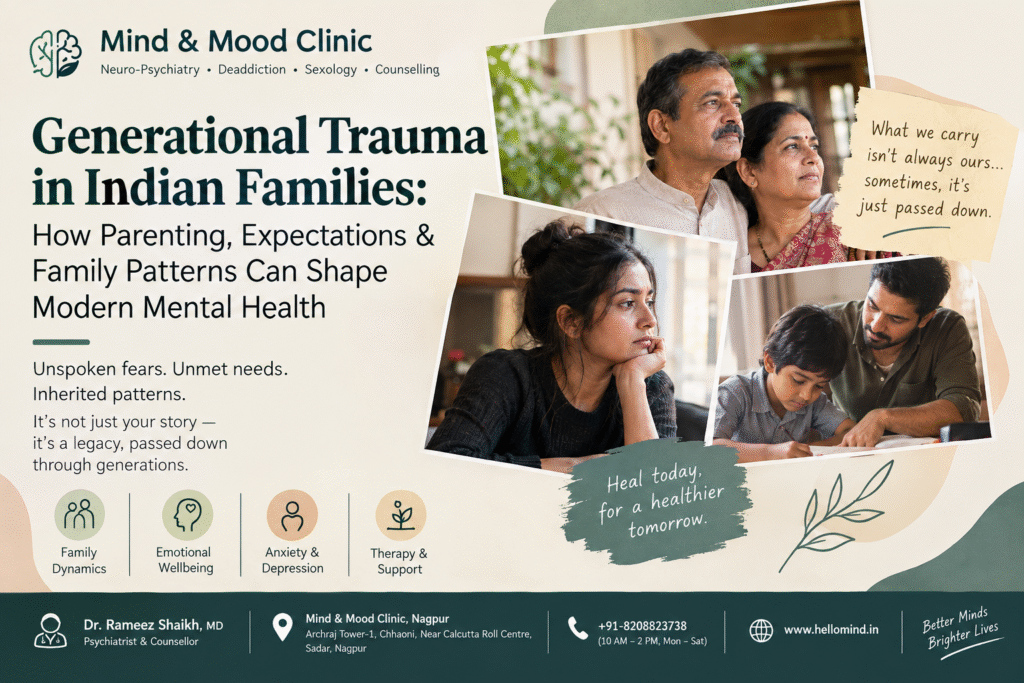
“We went through much worse. Why can’t you handle this?”
“In our family, nobody talks about mental health.”
“Parents know what is best for their children.”
“What will people say?”
For many Indians, these sentences may sound familiar.
They may have been heard during childhood, adolescence, relationships, career decisions, marriage discussions, or moments of emotional distress.
Indian families can provide enormous emotional, practical, and social support. Family relationships can be a major source of resilience.
At the same time, some family patterns can unintentionally pass stress, fear, rigid expectations, and unhealthy ways of dealing with emotions from one generation to another.
This is sometimes discussed under the concept of generational trauma or intergenerational trauma.
It does not mean that every strict parent has caused trauma or that every family tradition is harmful.
Rather, it helps us understand how unresolved experiences, beliefs, coping patterns, and family behaviours can sometimes influence the next generation.
And in today’s rapidly changing India, the conflict between traditional expectations and modern lifestyles can become particularly challenging.
What Is Generational Trauma?
Generational trauma refers to the way the effects of severe or unresolved experiences may influence subsequent generations through a combination of psychological, behavioural, family, social, and sometimes biological pathways.
For example, imagine a parent who grew up in extreme financial insecurity.
They may have learned:
“Money is never safe.”
As an adult, they may become extremely focused on financial security.
They may push their child toward a highly stable career.
The child may hear:
“You must become a doctor, engineer, government officer, or you have failed.”
The parent may believe they are protecting the child.
The child may experience the message as pressure.
The original fear of poverty has now influenced another generation.
This does not mean the parent intentionally harmed the child.
It means that unresolved fear can sometimes be transmitted through parenting and family behaviour.
Generational Trauma Is More Than “Bad Parenting”
It is easy to blame parents.
But families are complicated.
Many parents are themselves products of their circumstances.
A parent who grew up hearing:
“Don’t complain.”
may genuinely believe that teaching children to tolerate everything makes them stronger.
A parent who experienced financial hardship may become highly controlling about their child’s career.
A parent who experienced social rejection may become excessively concerned about reputation.
A parent who never received emotional support may not know how to provide emotional support.
In many cases, the behaviour is not driven by a desire to hurt.
It may be an attempt to protect, control uncertainty, or prevent the child from experiencing the difficulties the parent experienced.
Understanding this does not mean ignoring harmful behaviour.
It simply helps us understand where some family patterns come from.
The Indian Family Context
Indian families are diverse.
There is no single Indian parenting style.
Urban and rural families, different regions, socioeconomic groups, religions, communities, and generations can have very different experiences.
However, some themes are commonly encountered in mental-health conversations.
These may include:
- strong academic expectations
- pressure to choose particular careers
- emphasis on family reputation
- comparison with relatives or peers
- expectations around marriage
- limited discussion of emotional problems
- respect for parental authority
- difficulty openly disagreeing with elders
- pressure to maintain family harmony
- expectations of financial responsibility
- gender-related expectations
- reluctance to seek psychiatric help
None of these automatically constitutes trauma.
The psychological impact depends on how they are experienced, how rigid they are, and whether they create persistent distress or impairment.
“We Suffered, So You Should Be Strong Too”
One of the most powerful patterns can be the comparison of suffering.
A parent may say:
“At your age, I was already supporting my family.”
Or:
“We never had these problems.”
Or:
“You have everything. What are you stressed about?”
The intention may be motivational.
But the child may interpret it as:
“My feelings don’t matter.”
Over time, they may stop discussing emotional difficulties.
They learn to hide anxiety.
They hide sadness.
They hide relationship problems.
Eventually, they may become adults who are highly functional externally but emotionally disconnected internally.
Example: The Successful Son Who Cannot Say “I’m Struggling”
Consider Rahul, a 30-year-old professional living in Nagpur.
Rahul grew up in a family where academic achievement was extremely important.
His parents worked hard and sacrificed financially to provide him with opportunities.
Whenever Rahul received a high score, he was praised.
Whenever he failed, he was told:
“You need to work harder.”
Nobody intended to harm him.
His parents genuinely wanted him to succeed.
Rahul eventually became professionally successful.
But he developed a deep belief:
“My value depends on my performance.”
At work, he cannot tolerate mistakes.
He constantly compares himself with colleagues.
He works late even when unnecessary.
He finds it difficult to relax.
When his manager criticizes his work, he spends the entire night thinking about it.
His parents are proud of him.
But Rahul privately feels exhausted.
This is an important distinction:
A family can love a child deeply and still unintentionally pass on unhealthy beliefs about achievement, failure, or emotional expression.
When “What Will People Say?” Shapes Mental Health
Social reputation can have an important role in family decisions.
For some people, the question is not:
“What is best for my child?”
but:
“What will relatives think?”
This can affect:
- career choices
- marriage
- divorce
- mental-health treatment
- relationships
- gender expression
- lifestyle choices
- financial decisions
A young adult may want to make an independent decision but feel intense guilt because they fear disappointing their family.
The resulting conflict can contribute to:
- anxiety
- excessive guilt
- overthinking
- low self-esteem
- anger
- emotional exhaustion
- relationship difficulties
Why Emotional Conversations Can Be Difficult in Indian Families
Many adults were not taught emotional vocabulary during childhood.
They may know how to say:
“Study harder.”
“Eat properly.”
“Get a good job.”
“Save money.”
But they may struggle to say:
“Are you emotionally okay?”
“What are you worried about?”
“I understand that you’re hurt.”
“You don’t have to solve everything today.”
This emotional communication gap can continue across generations.
A child who never experienced open emotional conversations may become an adult who also struggles to discuss feelings with their partner or children.
The Cycle Can Continue Without Anyone Intending It
Consider this pattern:
Grandparent experiences hardship
↓
Parent develops fear and rigid coping strategies
↓
Parent becomes highly controlling or emotionally unavailable
↓
Child learns that emotions are unsafe or weakness is unacceptable
↓
Child becomes an anxious or perfectionistic adult
↓
Child may repeat some of the same patterns with their own children
This is one way intergenerational patterns can continue.
But there is an important part of the story missing:
The cycle can also stop.
Awareness can create an opportunity for change.
Generational Trauma Does Not Mean You Should Blame Your Parents
Understanding family patterns is not about creating a list of everything your parents did wrong.
Most parents are imperfect.
Most children are imperfect.
Families also contain love, sacrifice, resilience, humour, support, and connection.
A more useful question is:
“Which patterns from my family are helping me, and which ones are causing problems in my life today?”
For example:
Keep
- responsibility
- compassion
- family support
- resilience
- respect
- community connection
Reconsider
- emotional suppression
- excessive comparison
- fear-based parenting
- unconditional obedience
- perfectionism
- shame-based communication
- controlling adult children’s decisions
The goal is not to reject your family.
The goal is to develop healthier ways of relating.
How Generational Patterns Can Affect Anxiety
Suppose a child grows up hearing:
“Be careful.”
“Don’t trust anyone.”
“Something bad will happen.”
“You must always be prepared.”
The child may learn to constantly anticipate problems.
As an adult, this can sometimes appear as:
- excessive worrying
- overthinking
- catastrophising
- difficulty relaxing
- fear of failure
- perfectionism
- reassurance seeking
- difficulty making decisions
The original family environment may not be the only cause.
But it can become one factor shaping the person’s beliefs and coping style.
“Good Children Don’t Say No”
Another important family pattern involves difficulty establishing boundaries.
A child may learn:
“Good children obey.”
As an adult, they may struggle to say no to:
- parents
- relatives
- colleagues
- partners
- friends
They may repeatedly put other people’s needs before their own.
Eventually, resentment and emotional exhaustion can develop.
Healthy adulthood does not require rejecting parents or family.
It involves learning that respect and boundaries can exist together.
Career Pressure and Mental Health
Career expectations can become another source of intergenerational conflict.
Parents may encourage careers they believe provide:
- stability
- social respect
- financial security
- predictable employment
Young adults may increasingly value:
- personal interest
- work-life balance
- entrepreneurship
- creative careers
- flexibility
- meaning and purpose
Neither generation necessarily has bad intentions.
They may simply be responding to different economic and social realities.
Conflict occurs when the conversation becomes:
“My way or nothing.”
rather than:
“Let’s understand why we see this differently.”
Marriage Expectations and Mental Health
Marriage remains an important part of many Indian families.
For some adults, however, family expectations around marriage can become a major source of psychological stress.
Questions such as:
“When are you getting married?”
“Why are you rejecting good proposals?”
“What will relatives say?”
may seem harmless when asked occasionally.
But repeated pressure can become emotionally exhausting.
The situation can become more difficult when an individual’s preferences conflict strongly with family expectations.
Open communication, boundaries, and professional support may help when conflict becomes overwhelming.
Can Generational Trauma Be Healed?
People often ask:
“If my childhood affected me, am I permanently damaged?”
No.
Human beings are capable of change.
The brain and psychological patterns are not completely fixed.
Awareness, supportive relationships, healthy environments, psychotherapy, lifestyle changes, and appropriate psychiatric treatment can help people develop healthier ways of coping.
Therapy may help someone understand:
“This reaction belongs to something I learned earlier in life. I don’t necessarily have to repeat it now.”
That realisation can be powerful.
How Therapy Can Help Break the Cycle
Psychotherapy can provide a safe space to explore:
- family relationships
- childhood experiences
- emotional neglect
- anxiety
- guilt
- perfectionism
- people-pleasing
- anger
- boundaries
- relationship patterns
- self-esteem
- fear of disappointing others
Depending on the person’s needs, approaches such as Cognitive Behavioural Therapy (CBT) and other evidence-based therapies may be considered.
The goal is not to determine who was right or wrong.
The goal is to understand:
“What happened, how did I learn to respond, and what can I do differently now?”
You Can Respect Your Parents Without Repeating Everything
One of the most important lessons of adulthood is:
You can love your family without repeating every family pattern.
You can appreciate your parents’ sacrifices and still recognise that some beliefs no longer work for you.
You can respect elders and still establish boundaries.
You can value family and still seek professional mental-health support.
You can be grateful for your upbringing and still work on its difficult parts.
Healing does not require hatred.
Sometimes healing means understanding.
What Can Parents Do Differently?
Parents do not need to become perfect.
Small changes can have a significant impact.
Instead of:
“Stop crying.”
Try:
“I can see that you’re upset. Tell me what happened.”
Instead of:
“Everyone is doing better than you.”
Try:
“What support would help you improve?”
Instead of:
“We sacrificed everything for you.”
Try:
“We want you to build a life that is meaningful to you.”
Instead of:
“Don’t talk about family problems outside.”
Try:
“If you’re struggling, you can seek appropriate help.”
These small changes can make emotional conversations safer.
What Can Adult Children Do?
You cannot rewrite your childhood.
But you can influence what happens next.
Start by asking:
What beliefs did I learn about emotions?
Was asking for help considered weakness?
Did I learn that mistakes were unacceptable?
Do I constantly fear disappointing my family?
Do I feel guilty whenever I set boundaries?
Do I struggle to make decisions without approval?
Am I repeating these patterns in my relationships?
Awareness is the first step.
The next step may involve learning new ways of communicating and responding.
When Should You Consult a Psychiatrist?
Family conflict does not automatically mean that someone has a psychiatric disorder.
However, professional help may be appropriate when emotional difficulties become persistent or significantly affect daily life.
Consider consulting a psychiatrist in Nagpur if you experience:
- persistent anxiety
- panic attacks
- depression
- severe overthinking
- significant sleep problems
- emotional exhaustion
- recurrent anger or irritability
- relationship difficulties
- inability to function at work
- persistent guilt or hopelessness
- loss of interest in previously enjoyable activities
A psychiatric assessment can help determine whether symptoms are related to an anxiety disorder, depressive disorder, trauma-related condition, or another mental-health concern.
Treatment may include psychotherapy, lifestyle interventions, medication when clinically indicated, or a combination.
Breaking the Cycle Does Not Mean Breaking the Family
Sometimes people misunderstand the idea of healing from generational trauma.
They think:
“If I set boundaries, I’m disrespecting my parents.”
Not necessarily.
Healthy boundaries can actually make relationships more sustainable.
The goal is not:
“I don’t need my family.”
The goal can be:
“I love my family, but I also need space to make healthy decisions for myself.”
That difference can change relationships.
Final Thought
Every generation inherits something from the generation before it.
Sometimes it is:
love.
Sometimes:
resilience.
Sometimes:
fear.
Sometimes:
silence.
Sometimes:
unspoken expectations.
We cannot choose everything we inherit.
But as adults, we can decide what we want to pass forward.
Perhaps healing begins when someone in the family finally says:
“This is how things have always been—but we can learn a healthier way.”
That person does not have to blame the previous generation.
They simply have to become aware.
And sometimes, one person’s awareness can become the beginning of a healthier family pattern for the next generation.
Frequently Asked Questions
What is generational trauma in Indian families?
Generational or intergenerational trauma describes how the effects of difficult experiences, beliefs, coping mechanisms, and family patterns can sometimes influence subsequent generations. It does not mean that every family tradition or strict parenting practice causes trauma.
Is strict parenting always traumatic?
No. Parenting exists on a spectrum, and cultural context matters. Firm boundaries and expectations are not automatically harmful. Problems may arise when parenting involves persistent fear, humiliation, emotional invalidation, excessive control, or other behaviours that cause significant distress.
Can family expectations cause anxiety?
Strong family expectations can sometimes contribute to stress or anxiety, particularly when a person feels they cannot make independent choices or fears severe rejection for disappointing their family. Anxiety can have many causes, so an individual assessment is important.
Can generational trauma be treated?
The patterns associated with difficult family experiences can be addressed through psychotherapy and, when clinically indicated, psychiatric treatment. People can learn healthier emotional regulation, communication, boundaries, and coping strategies.
Do I have to blame my parents to heal?
No. Understanding family patterns does not require blaming anyone. It can be more useful to understand what happened, how it affected you, and what you want to do differently now.
Can I love my parents and still set boundaries?
Yes. Healthy boundaries and family relationships can coexist. Boundaries can help people communicate their needs while maintaining respectful relationships.
When should I see a psychiatrist in Nagpur?
Consider professional help when anxiety, depression, sleep problems, excessive overthinking, emotional distress, or family-related difficulties persist and interfere with your relationships, work, or daily functioning.
Medical Disclaimer
This article is intended for general mental-health education and awareness. “Generational trauma” or “intergenerational trauma” is not, by itself, a formal psychiatric diagnosis. Family experiences affect individuals differently, and an online article cannot determine the cause of a person’s symptoms. If you are experiencing persistent anxiety, depression, sleep difficulties, relationship problems, or significant emotional distress, consult a qualified mental-health professional.
Dr. Rameez Shaikh, MD
Mind & Mood Clinic, Nagpur
Psychiatrist & Counsellor
Archraj Tower-1, Chhaoni, Near Calcutta Roll Centre, Sadar, Nagpur
Appointment: +91-8208823738
Website: www.hellomind.in

Dr. Rameez Shaikh (MBBS, MD, MIPS) is a consultant Psychiatrist, Sexologist & Psychotherapist in Nagpur and works at Mind & Mood Clinic. He believes that science-based treatment, encompassing spiritual, physical, and mental health, will provide you with the long-lasting knowledge and tool to find happiness and wholeness again.
Dr. Rameez Shaikh, a dedicated psychiatrist , is a beacon of compassion and understanding in the realm of mental health. With a genuine passion for helping others, he combines his extensive knowledge and empathetic approach to create a supportive space for his patients.