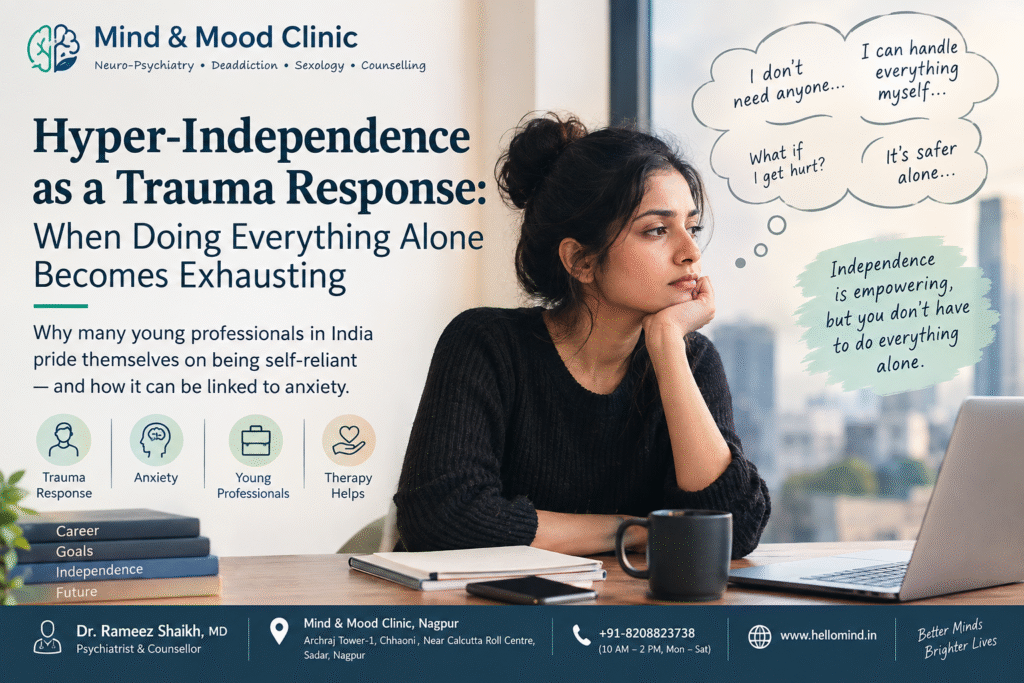
“I don’t need anyone.”
“I can handle everything myself.”
“Why should I ask someone for help?”
“If I depend on people, I’ll only be disappointed.”
For many young professionals in India, these statements can sound like confidence.
Being independent is often admired. We are taught to become financially independent, emotionally strong, responsible, and capable of managing our own lives.
But sometimes, independence stops being a choice and becomes a survival strategy.
A person may look extremely confident from the outside while internally feeling anxious, exhausted, lonely, and afraid of depending on anyone.
This pattern is sometimes called hyper-independence.
Hyper-independence is not a formal psychiatric diagnosis. Rather, it is a term used to describe a pattern in which a person feels an intense need to handle everything alone and finds it difficult to trust, depend on, or accept help from others.
For some people, this pattern may develop after experiences of emotional neglect, betrayal, instability, rejection, excessive responsibility, or trauma.
And underneath the sentence “I can do everything myself” there may sometimes be another message:
“I learned that depending on people is not safe.”
What Is Hyper-Independence?
Healthy independence means:
“I can manage things myself, but I can also ask for help when I need it.”
Hyper-independence can look more like:
“I must manage everything myself because I cannot trust anyone.”
The difference is important.
A psychologically healthy person can move between independence and dependence depending on the situation.
For example:
- They can solve a problem themselves.
- They can ask a friend for support.
- They can delegate work.
- They can accept emotional comfort.
- They can admit when they are struggling.
- They can trust others gradually.
Someone experiencing hyper-independence may find these things surprisingly difficult.
They may feel uncomfortable when someone offers help.
They may think:
“I don’t want to owe anyone anything.”
Or:
“I’ll just do it myself; it’ll be easier.”
Why Does Hyper-Independence Develop?
There is no single cause.
Different people develop this pattern for different reasons.
1. Emotional neglect during childhood
A child who repeatedly learns that their emotional needs are ignored may eventually stop expressing those needs.
Imagine a child saying:
“I’m scared.”
But nobody listens.
The child eventually learns:
“There is no point asking for comfort.”
As the child grows older, asking for emotional support may feel unnatural or even uncomfortable.
2. Having to grow up too early
Some children experience circumstances where they have to become responsible much earlier than expected.
They may have to:
- take care of younger siblings
- manage household responsibilities
- deal with family conflict
- emotionally support a parent
- perform well academically despite problems at home
They may receive praise for being “mature” and “strong.”
But underneath that strength can be exhaustion.
As adults, they may continue believing:
“I have to handle everything.”
3. Betrayal or broken trust
Sometimes hyper-independence develops after a painful relationship.
For example, imagine Aman, a 29-year-old software professional in Bengaluru.
Aman trusted his partner completely. During a difficult period, he depended emotionally on her.
The relationship ended suddenly.
Afterward, Aman decided:
“Never again. I will never depend on anyone.”
He became extremely focused on work.
He stopped discussing problems with friends.
When he became sick, he refused help.
When he felt emotionally overwhelmed, he said:
“I’m fine.”
Everyone around him considered him strong.
But internally, Aman had become increasingly anxious.
His independence was no longer simply a personality preference.
It had become a protective wall.
The Indian Context: Why “I Can Handle Everything” Is Often Praised
In Indian families and workplaces, being self-sufficient can be strongly associated with maturity and success.
Young professionals may be expected to:
- build a career
- become financially independent
- support parents
- manage relationships
- maintain social responsibilities
- handle workplace pressure
- plan their future
There is nothing wrong with responsibility.
The problem begins when someone believes:
“I am not allowed to need anybody.”
This can become particularly difficult for professionals living away from their families in cities such as Nagpur, Mumbai, Pune, Bengaluru, Hyderabad, Delhi, or Gurgaon.
They may have demanding careers but very little emotional support.
They appear independent.
Inside, they may be struggling with anxiety, loneliness, perfectionism, or burnout.
When Independence Turns Into Anxiety
Hyper-independence can sometimes keep the nervous system in a state of constant alertness.
The person may feel:
“If I don’t control everything, something will go wrong.”
This can contribute to:
- excessive worrying
- difficulty relaxing
- overthinking
- irritability
- sleep problems
- perfectionism
- fear of making mistakes
- difficulty trusting others
- difficulty delegating
- emotional exhaustion
- relationship difficulties
The person may constantly feel responsible for preventing problems.
And when everything depends on them, their mind rarely gets permission to rest.
The Connection Between Control and Anxiety
One important psychological mechanism is perceived control.
When life has previously felt unpredictable, a person may try to create safety by controlling as many things as possible.
For example:
“If I do everything myself, nobody can disappoint me.”
“If I don’t depend on anyone, nobody can abandon me.”
“If I work harder, nothing will go wrong.”
“If I plan everything, I won’t be caught unprepared.”
Unfortunately, life cannot be completely controlled.
This creates a difficult cycle:
Fear → Need for control → Doing everything alone → Exhaustion → Anxiety → More control
The person works harder to feel safer, but eventually becomes even more exhausted.
“I Don’t Need Anyone” Can Sometimes Hide Fear
This is one of the most important things to understand.
A person who refuses help may not necessarily be arrogant.
They may be afraid.
Afraid of:
- rejection
- disappointment
- abandonment
- criticism
- being controlled
- becoming vulnerable
- owing someone something
- appearing weak
So instead of saying:
“I’m afraid that you may hurt me,”
they say:
“I don’t need you.”
Instead of:
“I’m overwhelmed,”
they say:
“I’ll handle it.”
Instead of:
“I need emotional support,”
they say:
“I prefer being alone.”
Hyper-Independence and Relationships
Hyper-independence can create difficulties even in loving relationships.
A partner may say:
“Let me help you.”
But the response may be:
“No, I’ve got it.”
Repeatedly.
Over time, the partner may feel emotionally excluded.
The hyper-independent person may then think:
“See? Relationships are exhausting.”
This can reinforce the belief that being alone is safer.
The person may genuinely want closeness while simultaneously fearing dependence.
This creates an emotional push-pull:
“I want someone close to me.”
but also:
“Don’t get too close.”
Why Asking for Help Can Feel So Difficult
For some people, asking for help creates an uncomfortable feeling of vulnerability.
They may think:
- “People will think I’m weak.”
- “I should be able to handle this.”
- “I don’t want to burden anyone.”
- “They’ll use this against me later.”
- “I cannot trust people.”
- “I should solve my own problems.”
These beliefs can become deeply ingrained.
Therapy can help a person examine whether these beliefs are still protecting them—or whether they are now limiting their life.
A Simple Example
Consider Priya, a 31-year-old professional working in Nagpur.
Priya is successful at work.
She pays her own bills, manages her responsibilities, rarely asks anyone for help, and is considered extremely dependable.
Her colleagues admire her.
Her family says:
“She is very strong.”
But Priya frequently lies awake at night thinking about work.
She finds it difficult to delegate tasks.
She becomes anxious when someone does something differently from the way she would do it.
When she feels emotionally low, she withdraws.
When her partner asks what is wrong, she says:
“Nothing.”
Eventually, Priya begins experiencing persistent anxiety and sleep difficulties.
The issue is not that Priya is independent.
The issue is that she feels she cannot safely depend on anyone.
That distinction matters.
Is Hyper-Independence Always Caused by Trauma?
No.
This is important.
Not every highly independent person has experienced trauma.
Personality, family environment, culture, life experiences, temperament, previous relationships, and personal values can all influence how someone approaches independence.
Similarly, being independent does not automatically mean that someone has anxiety or a psychological disorder.
The concern arises when the pattern causes significant:
- emotional distress
- anxiety
- loneliness
- relationship problems
- exhaustion
- sleep problems
- occupational difficulties
In such situations, professional assessment can be helpful.
How Can You Tell If Your Independence Has Become Unhealthy?
Ask yourself:
Do I find it extremely difficult to ask for help?
Do I feel uncomfortable when someone does something for me?
Do I believe that depending on others is dangerous?
Do I automatically assume that people will disappoint me?
Do I feel responsible for everything?
Do I struggle to delegate even when overwhelmed?
Do I hide emotional problems from everyone?
Do I feel guilty when I need support?
Do I become anxious when I cannot control a situation?
Do I want close relationships but simultaneously push people away?
If several of these questions strongly resonate with you, it may be worth exploring the underlying reasons rather than simply trying to become even more independent.
How Therapy Can Help
The goal of therapy is not to make someone dependent on others.
The goal is flexibility.
A person can learn:
“I can take care of myself, and I can also allow trustworthy people to support me.”
Therapy may explore:
- childhood experiences
- attachment patterns
- past relationships
- emotional neglect
- trust difficulties
- anxiety
- perfectionism
- fear of vulnerability
- beliefs about weakness and dependence
- healthy boundaries
- emotional regulation
Approaches such as Cognitive Behavioural Therapy (CBT) and other evidence-based psychotherapeutic approaches may be useful depending on the individual’s difficulties.
You Don’t Have to Carry Everything Alone
Strength does not mean never needing anyone.
Strength can also mean knowing when to say:
“I need help.”
You can be financially independent and still need emotional support.
You can be successful and still experience anxiety.
You can be capable and still need someone to listen.
You can be strong and still have difficult days.
And perhaps the healthier goal is not:
“I don’t need anyone.”
but:
“I can stand on my own, and I can also lean on people I trust.”
That is not weakness.
That is psychological flexibility.
When Should You Consult a Psychiatrist?
Consider consulting a mental-health professional if independence-related anxiety is accompanied by:
- persistent excessive worrying
- panic attacks
- significant sleep disturbance
- persistent sadness
- emotional exhaustion
- inability to relax
- severe irritability
- relationship difficulties
- loss of interest in daily activities
- difficulty functioning at work
- recurrent thoughts of hopelessness or self-harm
A psychiatrist in Nagpur can assess whether the symptoms are related to an anxiety disorder, depression, trauma-related difficulties, or another mental-health condition.
Treatment may involve psychotherapy, lifestyle interventions, medication when clinically indicated, or a combination of approaches.
Final Thought
Sometimes the strongest-looking person in the room is the person who has learned never to ask for help.
Their independence may have once protected them.
But a strategy that helped someone survive a difficult period may not always be necessary forever.
You don’t have to prove your strength by carrying everything alone.
Sometimes real strength begins when you finally allow yourself to say:
“I can handle many things by myself—but I don’t have to handle everything alone.”
Frequently Asked Questions
Is hyper-independence a mental disorder?
No. Hyper-independence is not a formal psychiatric diagnosis. It describes a behavioural and emotional pattern that may occur for different reasons, including past difficult experiences, anxiety, attachment-related difficulties, or personality factors.
Is hyper-independence related to trauma?
It can be. Some people develop extreme self-reliance after experiences involving emotional neglect, instability, betrayal, rejection, or other stressful experiences. However, hyper-independence does not necessarily mean a person has experienced trauma.
Can hyper-independence cause anxiety?
The pattern can contribute to anxiety when a person feels responsible for controlling everything, cannot delegate, cannot trust others, or believes they must solve every problem alone.
How do I stop being hyper-independent?
Start by noticing when you automatically reject help. Gradually practise accepting reasonable support from trustworthy people, examine beliefs about vulnerability, and consider psychotherapy if the pattern is causing significant distress.
Should I see a psychiatrist or psychologist?
It depends on your symptoms. A psychologist or therapist can help explore emotional patterns and provide psychotherapy. A psychiatrist can assess for psychiatric conditions and determine whether medication or other medical treatment is appropriate. Sometimes both can work together.
Where can I consult a psychiatrist in Nagpur?
For psychiatric consultation in Nagpur, you may contact Mind & Mood Clinic, Nagpur, for an assessment with Dr. Rameez Shaikh, MD.
Medical Disclaimer
This article is intended for general mental-health education and awareness. Hyper-independence is not a formal psychiatric diagnosis, and the information above cannot replace an individual psychiatric or psychological assessment. If you are experiencing persistent anxiety, depression, sleep problems, relationship difficulties, or significant emotional distress, consult a qualified mental-health professional.
Dr. Rameez Shaikh, MD
Mind & Mood Clinic, Nagpur
Psychiatrist & Counsellor
Archraj Tower-1, Chhaoni, Near Calcutta Roll Centre, Sadar, Nagpur
Appointment: +91-8208823738
Website: www.hellomind.in

Dr. Rameez Shaikh (MBBS, MD, MIPS) is a consultant Psychiatrist, Sexologist & Psychotherapist in Nagpur and works at Mind & Mood Clinic. He believes that science-based treatment, encompassing spiritual, physical, and mental health, will provide you with the long-lasting knowledge and tool to find happiness and wholeness again.
Dr. Rameez Shaikh, a dedicated psychiatrist , is a beacon of compassion and understanding in the realm of mental health. With a genuine passion for helping others, he combines his extensive knowledge and empathetic approach to create a supportive space for his patients.