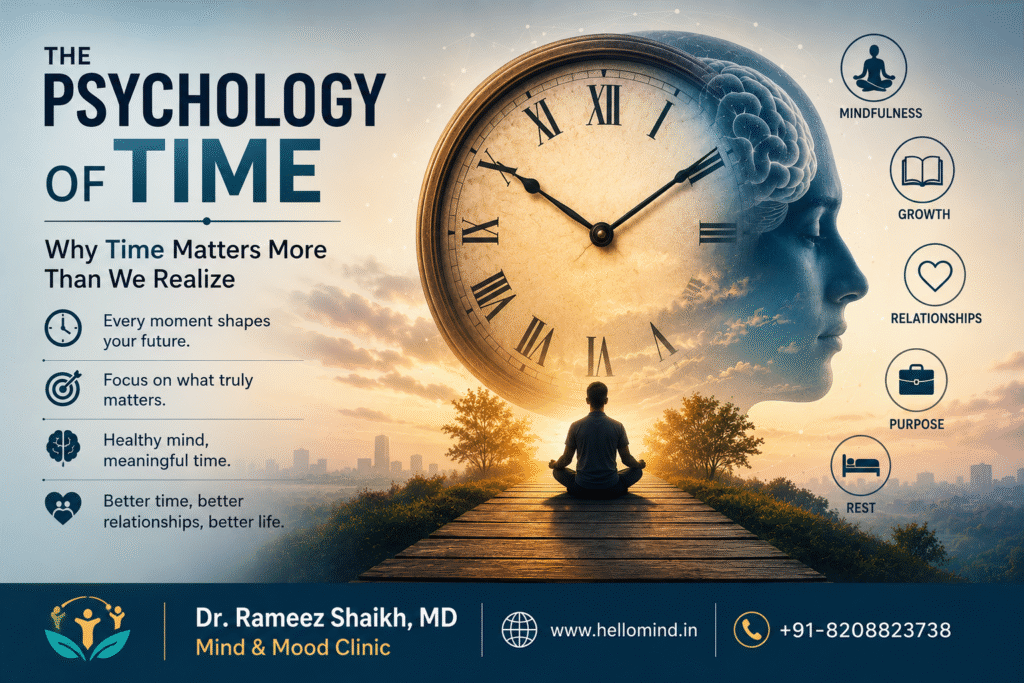
Time is one of the most valuable things we have, yet we often treat it as if we have an unlimited supply.
We postpone important decisions, spend hours scrolling on our phones, worry about the past, think endlessly about the future, and tell ourselves, “I’ll do it tomorrow.”
But tomorrow keeps moving.
From a psychological perspective, our relationship with time can influence our mood, stress levels, relationships, productivity, self-esteem, and overall mental well-being.
Understanding the psychology of time is not simply about becoming more productive. It is about learning how to use your limited time in a way that supports the life you actually want to live.
Why Is Time So Important in Psychology?
Time cannot be stored, purchased, or recovered once it has passed.
Money can sometimes be earned again. Opportunities may return. Material possessions can be replaced.
Time is different.
Every day contains a limited number of hours. How we spend those hours gradually shapes our experiences, habits, relationships, careers, and mental health.
Psychology teaches us that our experience of time is not always the same as clock time.
For example:
- Five minutes can feel extremely long when you are anxious.
- Two hours can disappear while you are enjoying yourself.
- A difficult period of life may feel as if it will never end.
- Years can seem to pass quickly when we become absorbed in routine.
This means that our relationship with time is both objective and psychological.
The Psychology of Wasting Time
Most people know that time is important. Yet almost everyone wastes time occasionally.
Why?
Because the human brain naturally tends to seek immediate comfort and reward.
Checking social media may provide an instant reward.
Watching another video feels easier than starting a difficult task.
Sleeping an extra hour can feel more comfortable than facing something stressful.
Avoiding an uncomfortable conversation can provide temporary relief.
The problem is that repeated short-term choices can create long-term consequences.
You may spend a few minutes avoiding something today, but repeated avoidance can eventually create:
- Stress
- Guilt
- Anxiety
- Missed opportunities
- Poor productivity
- Relationship problems
- Reduced confidence
Therefore, time management is not only a productivity issue.
It is also a psychological issue.
Why Do We Procrastinate?
Procrastination is often misunderstood as laziness.
In reality, procrastination can be connected to emotions.
People may delay tasks because they feel:
- Overwhelmed
- Anxious
- Bored
- Afraid of failure
- Afraid of criticism
- Perfectionistic
- Uncertain about where to begin
For example, a student may keep postponing studying not because they do not care about their future, but because thinking about the examination creates anxiety.
Similarly, someone may avoid applying for a job because they fear rejection.
Someone else may delay starting a business because they are afraid of making mistakes.
In these situations, procrastination can become a way of escaping uncomfortable emotions.
The temporary relief reinforces the behavior.
The person feels better for a short time—but later experiences more stress.
Time and Mental Health
Our use of time can have a significant influence on psychological well-being.
When life becomes unstructured, people may experience a cycle such as:
Poor routine → delayed tasks → guilt → stress → avoidance → more delayed tasks
Over time, this can contribute to emotional exhaustion.
A balanced routine, on the other hand, can provide:
- Structure
- Predictability
- A sense of control
- Better organization
- Time for relationships
- Time for relaxation
- Opportunities for meaningful activities
This does not mean every minute of the day needs to be scheduled.
In fact, excessive scheduling can sometimes create additional stress.
The goal is healthy structure, not perfection.
The Difference Between Being Busy and Being Productive
Modern life often glorifies being busy.
People say:
“I’m extremely busy.”
“I haven’t had time to breathe.”
“I work all day.”
But being busy does not necessarily mean that we are using our time effectively.
You can spend ten hours doing things and still avoid the one task that actually matters.
Productivity is not about doing more and more.
It is about spending time on things that are meaningful and important.
Ask yourself:
“If I could accomplish only three important things today, what would they be?”
This simple question can help separate genuine priorities from distractions.
Why We Keep Saying “I’ll Do It Tomorrow”
Tomorrow is psychologically attractive because it creates the feeling that we have more time.
We may tell ourselves:
- “I’ll start exercising tomorrow.”
- “I’ll call my parents tomorrow.”
- “I’ll study from tomorrow.”
- “I’ll stop wasting time tomorrow.”
- “I’ll take care of my mental health tomorrow.”
But tomorrow eventually becomes today.
Then the same thought appears again.
“I’ll start tomorrow.”
This cycle can continue for months or even years.
One of the most powerful ways to break it is to reduce the size of the first step.
Instead of saying:
“I will exercise for one hour.”
Try:
“I will walk for ten minutes.”
Instead of:
“I will finish the entire project today.”
Try:
“I will work on it for fifteen minutes.”
Starting is often psychologically harder than continuing.
The Importance of Living in the Present
Thinking about the past and future is a normal part of being human.
The problem arises when we become psychologically trapped in either one.
Living in the past
Constantly replaying past mistakes can lead to:
- Regret
- Guilt
- Shame
- Rumination
- Emotional distress
Learning from the past is useful.
Living inside it is not.
Living in the future
Constantly worrying about what might happen can contribute to:
- Anxiety
- Overthinking
- Fear
- Uncertainty
- Difficulty relaxing
Planning for the future is healthy.
Constantly fearing it can become exhausting.
The present moment is where life actually happens.
Time and Relationships
One of the most important ways we show people that they matter is by giving them our time.
A person may not remember every gift you purchased for them.
But they may remember:
- The conversation you had when they were struggling.
- The evening you spent together.
- The time you listened without judging.
- The day you showed up when they needed you.
Relationships require time.
If work, social media, entertainment, and other responsibilities consume all our attention, relationships can gradually suffer.
Sometimes the most meaningful thing you can give another person is simply:
Your undivided attention.
Why Smartphones Make Time Feel Different
Technology has made many aspects of life easier, but it has also changed how we experience time.
A few minutes of scrolling can easily become thirty minutes.
One video becomes five.
A quick check of notifications becomes an hour of fragmented attention.
The psychological problem is not simply screen time.
It is automatic behavior.
If you repeatedly reach for your phone whenever you experience boredom, discomfort, or silence, the behavior can become habitual.
Try asking:
“Did I choose to use my phone, or did I use it automatically?”
That small distinction can increase awareness.
Time, Dopamine and Immediate Rewards
Our brain is strongly influenced by rewards.
Activities that provide immediate stimulation can become particularly attractive when compared with tasks whose rewards are delayed.
For example:
Social media → immediate stimulation
Studying → delayed reward
Exercise → delayed benefits
Saving money → future benefit
Building a career → long-term reward
This is one reason meaningful goals can be difficult to pursue consistently.
The solution is not to eliminate pleasure.
Instead, create a healthier balance between immediate enjoyment and long-term goals.
Why Small Decisions Matter
A single day may not appear particularly important.
But repeated days become weeks.
Weeks become months.
Months become years.
Your life is therefore shaped not only by major decisions but also by thousands of small decisions.
For example:
Ten minutes of reading every day may not feel significant.
But over months and years, those minutes accumulate.
Likewise, regularly spending an extra hour scrolling may appear harmless—but repeated over a long period, it represents a substantial amount of your life.
Small choices become patterns, and patterns become lifestyles.
How to Use Time More Meaningfully
You do not need a complicated productivity system.
Start with a few psychological principles.
1. Identify Your Priorities
Ask yourself:
“What actually matters to me?”
Your priorities may include:
- Health
- Family
- Career
- Education
- Relationships
- Personal growth
- Creativity
- Spirituality
- Rest
Your calendar should reflect your values—not only your obligations.
2. Stop Waiting for Motivation
Many people think:
“When I feel motivated, I’ll start.”
Often the opposite happens.
Action can create motivation.
Start with a small step even when you do not feel completely ready.
3. Break Large Tasks Into Smaller Steps
Large goals can overwhelm the brain.
Instead of:
“I need to change my entire life.”
Think:
“What is one thing I can do today?”
Small actions are easier to begin and repeat.
4. Create Time for Rest
Rest is not wasted time.
Sleep, relaxation, hobbies, social connection, and quiet time are important parts of psychological health.
Constant productivity is not the definition of a healthy life.
A healthy life requires both effort and recovery.
5. Practice Saying No
Every “yes” consumes some amount of your limited time.
Learning to say no to unnecessary commitments can protect your energy and attention.
You do not need to attend every event, answer every message immediately, or accept every request.
6. Protect Your Attention
Time and attention are connected.
You may technically have two free hours, but if those hours are constantly interrupted by notifications, you may accomplish very little.
Try creating periods of uninterrupted attention.
Even 20–30 minutes of focused work can be valuable.
A Simple Daily Time Check
At the end of each day, ask yourself five questions:
- What did I spend most of my time doing today?
- Did my actions match my priorities?
- What unnecessarily consumed my attention?
- What meaningful thing did I do today?
- What is one thing I want to do differently tomorrow?
This is not about judging yourself.
It is about developing self-awareness.
When Poor Time Management May Be a Mental Health Concern
Occasional procrastination or poor organization is normal.
However, persistent difficulties with concentration, motivation, planning, organization, sleep, anxiety, mood, or completing everyday responsibilities may sometimes be associated with underlying psychological difficulties.
Conditions such as anxiety disorders, depression, ADHD, obsessive-compulsive symptoms, and chronic stress can affect how a person manages time and tasks.
This does not mean that every person who procrastinates has a mental health disorder.
But if difficulties are persistent and significantly affecting your work, education, relationships, or daily functioning, speaking with a qualified mental health professional may be helpful.
You Don’t Need More Time—You Need More Awareness
Most people wish they had more time.
But sometimes the more important question is:
“What am I doing with the time I already have?”
You may not be able to control how many hours exist in a day.
You can, however, become more intentional about where your attention goes.
You can spend more time with people you love.
You can stop postponing important conversations.
You can take the first step toward a goal.
You can rest without feeling guilty.
You can seek help when something is affecting your mental health.
You can begin today instead of waiting for the perfect tomorrow.
Final Thoughts: Time Is a Psychological Resource
Time is more than numbers on a clock.
It is the space in which our relationships develop, our memories are created, our careers grow, our habits form, and our lives unfold.
We cannot control every event that happens to us.
But we can become more conscious of how we respond to the time available to us.
Don’t measure your life only by how much you accomplish. Measure it by how meaningfully you spend your time.
Because eventually, the question may not be:
“Did I have enough time?”
It may be:
“Did I spend my time on what truly mattered?”
Frequently Asked Questions
Why is time important for mental health?
A balanced use of time can provide structure, reduce unnecessary stress, support healthy routines, and create space for relationships, rest, and meaningful activities.
Why do people procrastinate?
Procrastination is often related to emotional factors such as anxiety, boredom, fear of failure, perfectionism, feeling overwhelmed, or difficulty starting a task.
Is wasting time bad for mental health?
Occasional relaxation and unproductive time are normal and healthy. The concern arises when excessive avoidance or distraction consistently interferes with responsibilities, relationships, or personal goals.
How can I stop wasting time?
Start by identifying your priorities, reducing distractions, breaking large tasks into smaller steps, protecting focused work periods, and reviewing how you spend your time each day.
How does overthinking affect time?
Overthinking can consume significant mental energy and keep a person focused on past events or hypothetical future problems instead of taking constructive action in the present.
When should I seek professional help for procrastination?
Consider professional support when difficulties with motivation, concentration, organization, anxiety, mood, or completing daily responsibilities persist and significantly interfere with your life.
Key Takeaway
Time management is not just about productivity. It is about psychological well-being, priorities, relationships, attention, and living intentionally.
You cannot save yesterday.
You cannot control tomorrow.
But you can decide what you do with today.

Dr. Rameez Shaikh (MBBS, MD, MIPS) is a consultant Psychiatrist, Sexologist & Psychotherapist in Nagpur and works at Mind & Mood Clinic. He believes that science-based treatment, encompassing spiritual, physical, and mental health, will provide you with the long-lasting knowledge and tool to find happiness and wholeness again.
Dr. Rameez Shaikh, a dedicated psychiatrist , is a beacon of compassion and understanding in the realm of mental health. With a genuine passion for helping others, he combines his extensive knowledge and empathetic approach to create a supportive space for his patients.