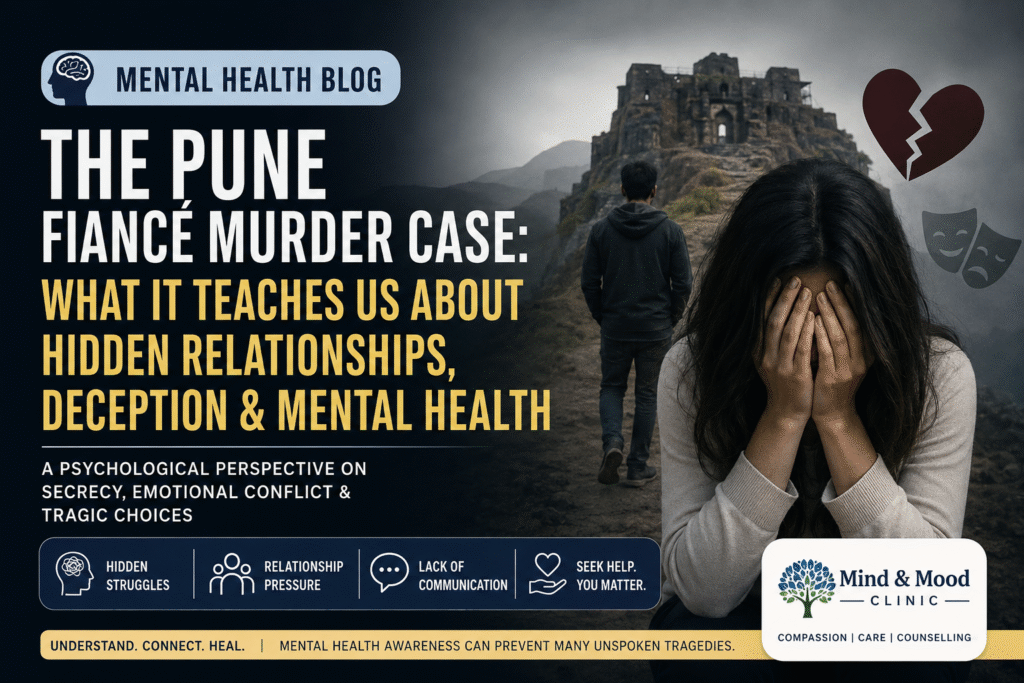
A Tragedy That Shocked India
The recent Pune fiancé murder case has captured national attention. According to investigators, what initially appeared to be a tragic accident at Lohagad Fort later became a murder investigation involving a young woman, her fiancé, and her alleged romantic partner. Reports suggest that the relationship dynamics were far more complicated than what family members and friends had seen on the surface. (The Times of India)
As mental health professionals, it is important to say one thing clearly:
Being accused of a crime does not automatically mean a person has a mental illness.
However, cases like these provide an opportunity to discuss important psychological themes that affect relationships, families, and society.
The Most Dangerous Problems Are Often Invisible
When people hear about such incidents, they often ask:
- “How could nobody see this coming?”
- “How can someone appear normal while hiding so much?”
- “Were there warning signs?”
The truth is that human beings are incredibly complex.
Some individuals maintain one image for family, another for friends, and a completely different reality in private. This does not necessarily indicate a psychiatric disorder. Sometimes it reflects fear, conflict avoidance, emotional immaturity, manipulation, or personality traits.
The Psychology of Living a Double Life
One of the most psychologically exhausting experiences is maintaining two conflicting realities.
Imagine:
- Being engaged to one person
- Emotionally attached to another
- Feeling pressure from family
- Fearing confrontation
- Worrying about social consequences
Many people in such situations experience:
- Anxiety
- Chronic stress
- Sleep disturbances
- Emotional confusion
- Feelings of being trapped
Most people resolve these conflicts through communication, ending relationships, seeking counselling, or refusing unwanted commitments.
Unfortunately, some individuals choose deception instead.
Why People Stay Silent Instead of Speaking the Truth
Many families assume that silence means agreement.
Psychologically, that is often not true.
People may stay silent because of:
Fear of Disappointing Family
Many young adults fear hurting parents or relatives.
Fear of Social Judgment
Questions such as:
- “What will people say?”
- “What about the wedding arrangements?”
- “What about our reputation?”
can create enormous pressure.
Fear of Conflict
Some individuals would rather avoid difficult conversations than face temporary discomfort.
Ironically, avoiding a difficult conversation often creates a much bigger disaster later.
The Warning Signs Families Often Miss
Not every warning sign predicts violence.
However, certain patterns deserve attention:
1. Extreme Reluctance Toward Marriage
Repeated hesitation, emotional withdrawal, or visible distress should never be ignored.
2. Secretive Behaviour
- Constant phone secrecy
- Hidden relationships
- Multiple conflicting stories
3. Sudden Personality Changes
A previously engaged and enthusiastic person becoming detached or indifferent.
4. Emotional Disconnect
When someone appears physically present but emotionally absent.
5. Lack of Honest Communication
The inability to openly discuss concerns often becomes the root of larger problems.
The Difference Between Mental Illness and Harmful Behaviour
This distinction is extremely important.
Many people assume:
“Only mentally ill people commit terrible acts.”
That is incorrect.
Most individuals with depression, anxiety, OCD, bipolar disorder, or schizophrenia are far more likely to harm themselves than others.
A harmful act may occur because of:
- Criminal intent
- Poor moral judgment
- Manipulation
- Personality traits
- Relationship conflicts
- Financial motives
- Jealousy
Mental illness is only one possible factor among many and often has no role at all.
What Is Lack of Remorse?
Media reports discussing an accused person’s emotional reaction often trigger public debate. Some reports in this case mentioned observations about emotional responses during questioning. (The US Sun)
Psychologically, apparent lack of remorse can have many explanations:
- Emotional shock
- Dissociation
- Psychological numbing
- Denial
- Fear
- Personality traits
- Genuine absence of guilt
Without a formal assessment, nobody can accurately determine which explanation applies.
This is why public speculation is often misleading.
Why Relationship Counselling Matters
Many tragedies begin with problems that seem ordinary:
- “I am not sure about this relationship.”
- “I love someone else.”
- “I feel trapped.”
- “I cannot tell my family.”
These are exactly the situations where professional counselling can help.
Counselling can assist individuals in:
- Making difficult decisions
- Communicating honestly
- Managing family pressure
- Ending relationships respectfully
- Preventing impulsive decisions
Lessons for Young Adults
If you are uncertain about a relationship:
✔ Speak honestly.
✔ Seek counselling early.
✔ Do not agree to marriage under pressure.
✔ Do not maintain multiple relationships through deception.
✔ Remember that temporary embarrassment is far better than lifelong regret.
Lessons for Parents
Parents often focus on compatibility, education, family background, and financial stability.
But one question is frequently overlooked:
“Does my child genuinely want this marriage?”
A reluctant “yes” is not true consent.
Open conversations can prevent immense suffering.
Final Thoughts
The Pune fiancé murder case is ultimately a story about more than crime. It highlights the consequences of secrecy, emotional avoidance, hidden relationships, and the failure of honest communication.
While the legal system will determine responsibility, the psychological lesson is already clear:
Problems that are hidden do not disappear. They grow.
Whether it is anxiety, depression, relationship conflict, family pressure, or emotional distress, seeking help early is always wiser than suffering in silence.
The strongest decision a person can make is not hiding the truth—it is facing it.
Disclaimer
This article discusses psychological themes arising from a publicly reported criminal case. It does not diagnose, label, or speculate about the mental health of any individual involved. Legal responsibility and factual findings remain subject to investigation and judicial proceedings.

Dr. Rameez Shaikh (MBBS, MD, MIPS) is a consultant Psychiatrist, Sexologist & Psychotherapist in Nagpur and works at Mind & Mood Clinic. He believes that science-based treatment, encompassing spiritual, physical, and mental health, will provide you with the long-lasting knowledge and tool to find happiness and wholeness again.
Dr. Rameez Shaikh, a dedicated psychiatrist , is a beacon of compassion and understanding in the realm of mental health. With a genuine passion for helping others, he combines his extensive knowledge and empathetic approach to create a supportive space for his patients.