A common situation many patients face
A young man came to the clinic with a concern:
“Doctor, I had sex once through a dating app… since then I feel I have some infection.”
He had:
- No major symptoms
- Already done tests (normal)
But still:
- Checking lymph nodes repeatedly
- Looking for spots on skin
- Googling symptoms daily
- Feeling anxious all the time
What is actually happening?
This is often not an infection problem.
It is a health anxiety pattern triggered by a stressful event.
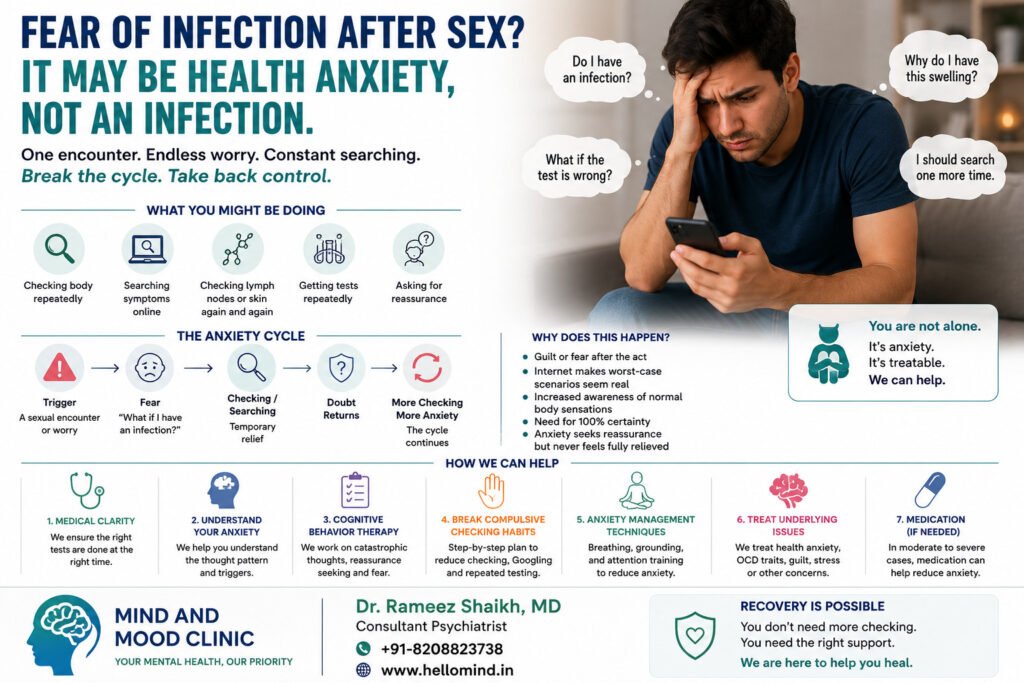
The anxiety cycle
Trigger → Fear → Checking → Temporary relief → Doubt → More checking
👉 This cycle keeps repeating and strengthens over time.
Why does this happen?
- Guilt or fear after the act
- Internet overexposure (worst-case thinking)
- Increased body awareness
- Need for 100% certainty
Common behaviors seen
- Repeated body checking
- Constant Google searches
- Repeated testing
- Seeking reassurance again and again
👉 These behaviors maintain the anxiety.
Important medical point
If:
- Proper tests are done at the right time
- Reports are normal
👉 The risk of serious infection is very low
But the anxiety continues because the problem becomes psychological.
What helps in this situation?
- Reduce Google searching
- Stop repeated checking
- Avoid unnecessary testing
- Stay engaged in routine
- Practice grounding techniques
How we can help
At the clinic, we approach this problem in a structured and supportive way.
1. Proper medical clarity
First, we ensure:
- Correct tests are done
- No actual medical issue is missed
This helps reduce genuine uncertainty.
2. Understanding your anxiety pattern
We help you understand:
- What triggered the fear
- How the anxiety cycle is working
👉 Awareness reduces fear intensity.
3. Cognitive Behavioral Therapy (CBT)
We work on:
- Challenging catastrophic thoughts
- Reducing reassurance-seeking behavior
- Building tolerance to uncertainty
4. Reducing compulsive checking
Step-by-step plan to:
- Stop body checking
- Reduce Google dependence
- Break the habit cycle
5. Anxiety management techniques
We teach:
- Breathing techniques
- Grounding exercises
- Attention-shifting methods
6. Addressing underlying issues
If present, we treat:
- Health anxiety
- OCD traits
- General anxiety
- Guilt or stress
7. Medication (if needed)
In moderate to severe cases:
- Anti-anxiety or OCD medications may be used
👉 This helps reduce intrusive thoughts and constant fear.
When should you seek help?
- You keep thinking about infection daily
- You cannot stop checking or Googling
- Tests are normal but fear continues
- It affects your work or sleep
Final message
Your fear feels real—but it is driven by anxiety, not evidence.
👉 More checking will not solve it
👉 Understanding and treatment will
Contact
Mind and Mood Clinic, Sadar, Nagpur
Dr. Rameez Shaikh, MD
📞 +91-8208823738
🌐 www.hellomind.in
Disclaimer
This article is for educational purposes only. Consult a qualified doctor for medical concerns and a psychiatrist for persistent anxiety.

Dr. Rameez Shaikh (MBBS, MD, MIPS) is a consultant Psychiatrist, Sexologist & Psychotherapist in Nagpur and works at Mind & Mood Clinic. He believes that science-based treatment, encompassing spiritual, physical, and mental health, will provide you with the long-lasting knowledge and tool to find happiness and wholeness again.
Dr. Rameez Shaikh, a dedicated psychiatrist , is a beacon of compassion and understanding in the realm of mental health. With a genuine passion for helping others, he combines his extensive knowledge and empathetic approach to create a supportive space for his patients.