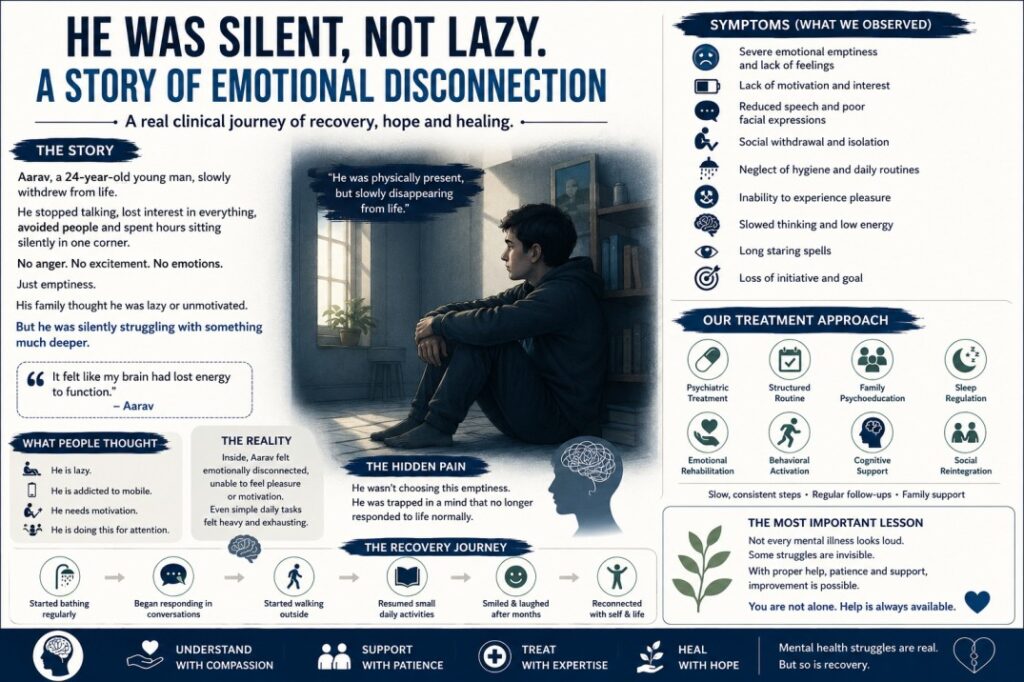
When Aarav (name changed) first came to the clinic, his family was not complaining about aggression, shouting, or bizarre behavior.
Their complaint was something quieter.
“He has stopped being himself.”
At first, everyone thought he was simply stressed.
He had become unusually silent over the past 2–3 years.
Slowly, he stopped talking during family conversations.
Then he stopped meeting friends.
Then he stopped caring about work.
Eventually, he would spend most of the day sitting alone in one corner of the room doing absolutely nothing for hours.
Not scrolling on his phone.
Not watching TV.
Not sleeping.
Just sitting.
Emotionless.
Blank.
His mother initially believed he was “lazy.”
His father became angry and repeatedly told him:
“You have no motivation.”
“You are wasting your life.”
“Why can’t you behave normally?”
But the reality was much deeper than lack of discipline.
Aarav described feeling as if:
“Something inside me has shut down.”
The Symptoms Nobody Understood
What made the family confused was that there was no dramatic behavior.
No violence.
No excitement.
No emotional reactions.
Instead, there was:
- severe emotional emptiness
- lack of motivation
- reduced speech
- poor facial expressions
- social withdrawal
- neglect of hygiene
- inability to experience pleasure
- reduced emotional connection
- long staring spells
- slowed thinking
- lack of initiative
Earlier, Aarav loved music.
Now he felt nothing while listening to it.
Earlier, he used to joke with cousins.
Now he barely responded with one-word answers.
Earlier, he wanted a career.
Now even brushing his teeth felt mentally exhausting.
This emotional decline was gradual and painful for the family to witness.
The hardest part?
He himself could not explain what was happening.
What People Around Him Thought
Relatives gave endless opinions:
“He is addicted to mobile.”
“He needs motivation.”
“He is attention seeking.”
“He is depressed because he is weak.”
“Force him to work.”
“He is just lazy.”
But inside, Aarav’s mind had become painfully slowed down.
Even basic daily tasks started feeling mentally heavy.
He later described:
“It felt like my brain had lost energy to function.”
The Hidden Emotional Pain
One of the saddest things about such conditions is that people often assume the patient “does not care.”
But many patients silently suffer because they are unable to express emotions normally anymore.
Aarav was not intentionally distant.
He was emotionally disconnected from himself too.
Sometimes his mother cried seeing him sit silently for hours staring at the wall.
She once asked:
“What are you thinking?”
He quietly replied:
“Nothing.”
And he genuinely meant it.
The Clinical Challenges
During assessment, it became clear that the major issue was not sadness alone.
There was:
- emotional blunting
- severe social withdrawal
- reduced spontaneous speech
- lack of motivation
- reduced emotional responsiveness
- cognitive slowing
- functional decline
These symptoms had slowly affected:
- relationships
- confidence
- work functioning
- self-care
- emotional expression
- social life
Conditions involving such symptoms are often misunderstood because they may not look dramatic from outside.
But internally, the person may feel disconnected from life itself.
Treatment and Recovery Process
Recovery was not overnight.
And one important thing families must understand is:
Improvement in such conditions often happens slowly and gradually.
The treatment approach involved:
- psychiatric treatment
- structured routine building
- family psychoeducation
- sleep regulation
- emotional rehabilitation
- behavioral activation
- cognitive support
- social reintegration
- regular follow-ups
Initially, even small improvements mattered.
First:
He started bathing regularly again.
Then:
He began responding slightly more during conversations.
Then:
He started walking outside for short durations.
Months later:
He slowly resumed small daily activities.
One day during follow-up, his mother smiled and said:
“He laughed at a joke after many months.”
For many people, that sounds small.
For this family, it felt enormous.
The Most Important Lesson
Not every severe mental illness looks loud.
Some conditions slowly erase emotional expression, motivation, personality, connection, and functioning so quietly that families mistake it for laziness or stubbornness.
But these patients are not “choosing” emptiness.
Many are silently trapped inside a mind that no longer responds to life normally.
And with proper psychiatric care, patience, family understanding, and long-term treatment —
improvement is possible.
Sometimes slow.
Sometimes frustrating.
But possible.
Final Message
If someone around you has suddenly:
- withdrawn socially
- stopped expressing emotions
- lost motivation completely
- become emotionally blank
- stopped caring about self-care
- become unusually silent
please do not immediately label them as lazy or irresponsible.
Some struggles are invisible.
And sometimes the person disappearing emotionally needs help much more than criticism.
🌿
— Dr. Rameez Shaikh
Psychiatrist & Counsellor

Dr. Rameez Shaikh (MBBS, MD, MIPS) is a consultant Psychiatrist, Sexologist & Psychotherapist in Nagpur and works at Mind & Mood Clinic. He believes that science-based treatment, encompassing spiritual, physical, and mental health, will provide you with the long-lasting knowledge and tool to find happiness and wholeness again.
Dr. Rameez Shaikh, a dedicated psychiatrist , is a beacon of compassion and understanding in the realm of mental health. With a genuine passion for helping others, he combines his extensive knowledge and empathetic approach to create a supportive space for his patients.