Every year on April 2nd, we observe World Autism Awareness Day—but honestly, awareness is just the beginning.
What we really need is understanding, acceptance, and empathy.
As a psychiatrist, I’ve often noticed that families don’t struggle because of autism itself—but because of confusion, stigma, and lack of guidance.
Let’s talk about autism in a way that feels real, especially in the Indian context.
What is Autism Spectrum Disorder (ASD)?
Autism Spectrum Disorder (ASD) is a neurodevelopmental condition that affects:
- Communication
- Social interaction
- Behavior and interests
It’s called a spectrum because every individual is different.
Early Signs of Autism
Parents often say:
“Doctor, we felt something was different… but we couldn’t explain it.”
Here’s what that “different” may look like.
1. Delayed Speech or Communication Issues
Example:
A 3-year-old boy in Nagpur doesn’t speak words like other children his age.
Instead of saying “mummy,” he:
- Pulls his mother’s hand toward objects
- Makes sounds but no clear words
Another child may repeat words (echolalia):
If you ask, “Do you want water?”, they reply:
“Want water?” instead of answering yes or no.
2. Poor Eye Contact
Example:
A child avoids looking at people while talking.
Parents often say:
“He listens, but doesn’t look at us.”
In Indian families, this is sometimes misinterpreted as:
- Shyness
- “Introverted nature”
But consistent lack of eye contact can be an early sign.
3. Lack of Social Interaction
Example:
During a family function:
- Other kids are playing together
- One child sits alone, spinning a toy car repeatedly
Or:
A child doesn’t respond when their name is called, making parents worry about hearing issues.
4. Repetitive Behaviors
These are very common.
Examples:
- Hand flapping when excited
- Spinning in circles
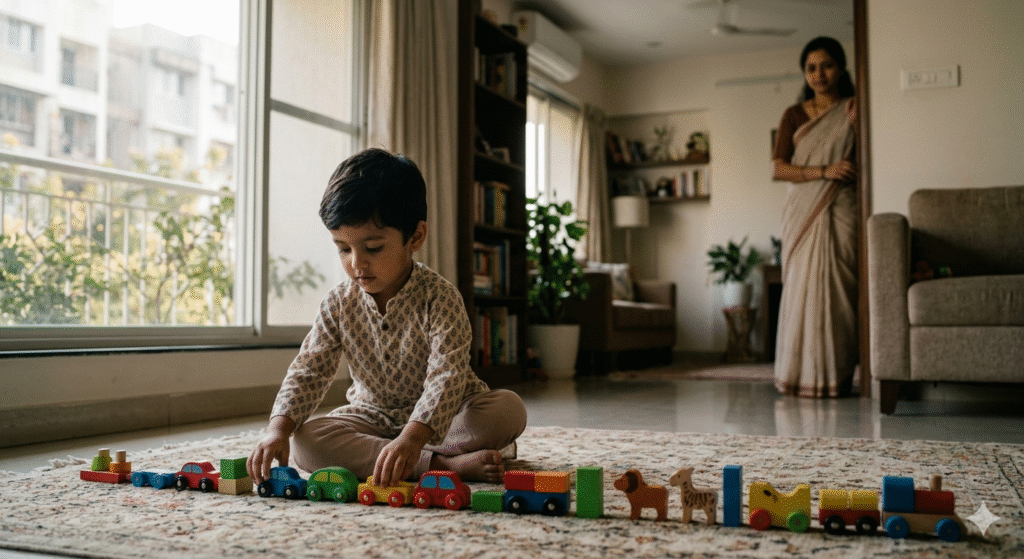
- Lining up toys instead of playing with them
A parent once told me:
“My daughter arranges her dolls in perfect order for hours but doesn’t play with them.”
5. Strong Need for Routine
Children with autism often resist change.
Example:
A child insists on:
- Taking the same route to school
- Eating food from the same plate
If anything changes, it may lead to:
- Meltdowns
- Crying
- Aggression
6. Sensory Sensitivities
This is something many people miss.
Examples:
- Covering ears during loud sounds (like crackers during Diwali)
- Refusing certain clothes due to texture
- Extreme reaction to smells or lights
7. Unusual Interests or Intense Focus
Example:
A child may become obsessed with:
- Train numbers
- Mobile phone logos
- One cartoon character
And talk about it repeatedly without noticing others’ interest.
Symptoms in Older Children and Adolescents
Sometimes autism is diagnosed later.
Examples:
Social Difficulty
- Difficulty making friends
- Not understanding jokes or sarcasm
Emotional Expression Issues
- Appearing “emotionless”
- Difficulty expressing feelings
Academic Patterns
- Very strong in certain subjects (like math)
- Struggling in others (like language or social science)
A Real Conversation from My Clinic
A mother once said:
“Doctor, he doesn’t call me ‘mumma’… but he knows exactly when I’m upset.”
That’s autism.
Not lack of emotion—but different expression of it.
Common Myths in India
Let’s clear a few:
❌ “Autism is caused by bad parenting”
✔️ No, it is neurodevelopmental
❌ “The child will never improve”
✔️ Early intervention can bring significant progress
❌ “He will outgrow it”
✔️ Autism doesn’t disappear, but skills can improve
What Should Parents Do?
1. Early Screening
If you notice delays, don’t “wait and watch” too long.
2. Therapy is Key
- Speech therapy
- Occupational therapy
- Behavioral therapy (ABA/CBT-based approaches)
3. Parent Training
Parents are the most important part of therapy.
Why World Autism Awareness Day Matters
Because awareness leads to:
- Early diagnosis
- Reduced stigma
- Better support systems
But more importantly—it reminds us that:
Different doesn’t mean less.
FAQs
1. Can autism be cured?
Autism is not “cured,” but managed with therapy and support.
2. At what age can autism be diagnosed?
As early as 18–24 months.
3. Is every speech delay autism?
No. But it should always be evaluated.
4. Can autistic children go to normal schools?
Yes, with the right support.
Call to Action
If you notice signs in your child, don’t ignore your instinct.
Early help can change the trajectory of a child’s life.
Let’s move from awareness to acceptance.
Disclaimer
This content is for educational purposes only and should not be considered medical advice. If you suspect autism or developmental concerns in your child, please consult a qualified professional.
Mind & Mood Clinic
Dr. Rameez Shaikh, MBBS, MD (Psychiatrist and Counsellor)

Dr. Rameez Shaikh (MBBS, MD, MIPS) is a consultant Psychiatrist, Sexologist & Psychotherapist in Nagpur and works at Mind & Mood Clinic. He believes that science-based treatment, encompassing spiritual, physical, and mental health, will provide you with the long-lasting knowledge and tool to find happiness and wholeness again.
Dr. Rameez Shaikh, a dedicated psychiatrist , is a beacon of compassion and understanding in the realm of mental health. With a genuine passion for helping others, he combines his extensive knowledge and empathetic approach to create a supportive space for his patients.