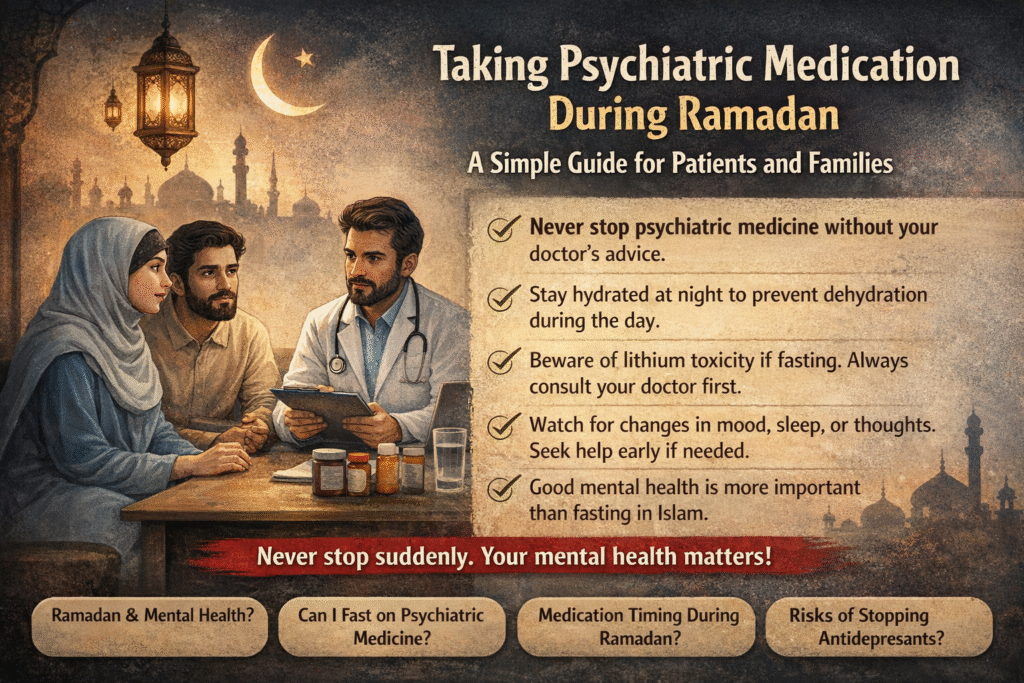
A Simple Guide for Patients and Families
Ramadan is a very special and spiritual month. Many people want to fast from sunrise to sunset. If you are taking psychiatric medicines for depression, anxiety, bipolar disorder, schizophrenia, or sleep problems, you may wonder:
“Can I fast?”
“Should I stop my medicine?”
“Will fasting affect my mental health?”
Let us understand this in very simple language.
🌙 First and Most Important Rule
Do NOT stop your psychiatric medicine on your own.
Even if it is “only for one month.”
Stopping suddenly can make you feel:
- Very anxious
- Irritable
- Dizzy
- Unable to sleep
- Depressed again
- Or even trigger a serious relapse
Some medicines can cause withdrawal symptoms if stopped suddenly.
Always talk to your psychiatrist before Ramadan starts.
🧠 Why Ramadan Can Affect Mental Health
During Ramadan:
- You do not eat or drink during the day
- Your sleep time changes
- You may drink more tea or coffee at night
- You may sleep less
These changes can affect:
- Your mood
- Your anxiety level
- Your medication levels
- Your energy
- Your thinking
For some people, especially those with bipolar disorder or severe depression, lack of sleep alone can trigger relapse.
💊 Can I Continue My Medicine While Fasting?
In most cases — yes, you can continue your medicines.
Your doctor may simply change the timing.
For example:
- Once daily medicines → take at Iftar (after sunset)
- Twice daily medicines → take at Iftar and Suhoor
- Night medicines → continue at night
Most antidepressants and antipsychotics can be safely continued.
⚠️ Medicines That Need Extra Care
1️⃣ Lithium
If you are taking lithium, you must be very careful.
Why?
Because lithium + dehydration can become dangerous.
Signs of lithium toxicity:
- Tremor
- Vomiting
- Confusion
- Feeling very unwell
If you are fasting:
- Drink plenty of water between Iftar and Suhoor
- Do not skip fluids
- Inform your doctor immediately if you feel unwell
Sometimes your doctor may advise:
- Blood test
- Dose adjustment
- Or in some cases, not fasting for health reasons
2️⃣ Benzodiazepines (for anxiety or sleep)
If you take medicines like clonazepam or alprazolam:
- Do not stop suddenly
- Sudden stopping can cause severe anxiety or even seizures
Your doctor may shift the dose to night time.
3️⃣ Sleeping Tablets
These can usually be taken at night after Iftar.
❌ What Happens If I Stop Medicine for One Month?
Many patients say:
“Doctor, I will stop medicine only during Ramadan.”
But this can cause:
- Depression coming back
- Panic attacks
- Mania in bipolar patients
- Psychosis relapse
- Severe insomnia
- Hospital admission
One relapse can take months to recover.
Your stability is very precious.
🧎♂️ Is It Allowed Not to Fast If I Am Sick?
Yes.
In Islam, health is very important.
If fasting harms your health, you are allowed not to fast.
Mental illness is a real illness — just like diabetes or heart disease.
If your psychiatrist advises not to fast for medical reasons, it is for your safety.
🌿 Simple Safety Tips During Ramadan
✔ Talk to your doctor 2–4 weeks before Ramadan
✔ Do not change medicine without medical advice
✔ Drink enough water at night
✔ Try to sleep at least 6–7 hours in total
✔ Avoid too much caffeine at night
✔ Inform family if you feel low or anxious
✔ Seek help early if mood worsens
🚨 Warning Signs You Should Not Ignore
During Ramadan, contact your doctor urgently if you notice:
- Very low mood
- Thoughts of self-harm
- Severe anxiety
- Not sleeping at all
- Feeling overly energetic or irritable
- Hearing voices or strange thoughts
- Severe vomiting (if on lithium)
Do not “wait and watch.”
Early treatment prevents complications.
❤️ Final Message
Ramadan is about peace, patience, and protection of life.
Ramadan is spiritually powerful — but psychiatric stability is medically critical.
Your mental health matters.
Your stability matters.
Your life matters.
Fasting is important — but your health is more important.
Islam gives permission to protect life. We can adjust timings, but stopping medication without supervision may cause relapse.
If you are unsure, talk to your psychiatrist. There is always a safe plan.

Dr. Rameez Shaikh (MBBS, MD, MIPS) is a consultant Psychiatrist, Sexologist & Psychotherapist in Nagpur and works at Mind & Mood Clinic. He believes that science-based treatment, encompassing spiritual, physical, and mental health, will provide you with the long-lasting knowledge and tool to find happiness and wholeness again.
Dr. Rameez Shaikh, a dedicated psychiatrist , is a beacon of compassion and understanding in the realm of mental health. With a genuine passion for helping others, he combines his extensive knowledge and empathetic approach to create a supportive space for his patients.