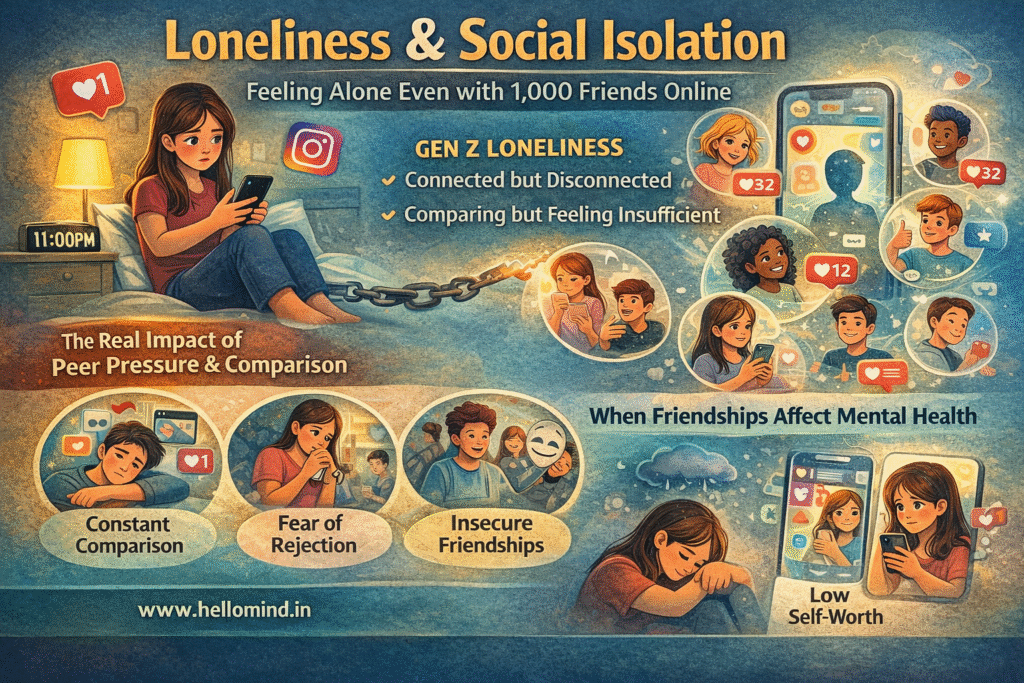
Loneliness & Social Isolation
A 17-year-old once told me in clinic:
“I have 1,200 followers… but no one I can call at 11 PM.”
That sentence explains modern loneliness better than any research paper.
We are the most digitally connected generation in history — yet Gen Z loneliness is rising at an alarming pace.
Let’s understand why.
The Illusion of Connection
Social media gives us:
- Notifications
- Likes
- Views
- Comments
- Group chats
These create the feeling of interaction.
But interaction is not the same as emotional connection.
True connection includes:
- Vulnerability
- Emotional safety
- Being understood without performing
- Being accepted without filters
Online spaces often reward performance, not authenticity.
Why Gen Z Feels Lonely Despite Being “Connected”
1. Quantity Over Quality
Having 1,000 online connections does not equal having 1 safe person.
Many young people report:
- Plenty of casual chats
- Very few deep conversations
The brain registers stimulation — but not emotional security.
2. Fear of Being “Too Real”
Online identity is curated.
Posting sadness feels risky.
Showing struggle feels embarrassing.
So people share:
- Success
- Humor
- Filters
- Highlights
But hide:
- Anxiety
- Confusion
- Self-doubt
This creates emotional isolation.
You are surrounded — but unseen.
Peer Pressure & Comparison: Why It Worsens Loneliness
1. Social Comparison Is Automatic
The brain constantly evaluates:
- Who is doing better?
- Who looks better?
- Who has more friends?
- Who is in a relationship?
Even when you don’t want to compare, your brain does.
This leads to:
- Reduced self-worth
- Instagram self-esteem issues
- Social media anxiety
- Fear of missing out (FOMO)
2. Peer Pressure to “Keep Up”
Gen Z faces subtle pressures:
- Dress a certain way
- Post regularly
- Attend events
- Maintain a social image
If you don’t participate, you feel left out.
If you participate, you feel exhausted.
Either way, loneliness increases.
3. Emotional Invalidations
When someone says:
- “Everyone feels lonely.”
- “You have so many friends.”
It minimizes the internal experience.
Loneliness is not about numbers.
It is about emotional depth.
The Psychology of Modern Loneliness
Loneliness activates the same brain regions as physical pain.
Humans are wired for:
- Attachment
- Belonging
- Emotional safety
When these needs are unmet, the brain reacts with:
- Anxiety
- Hypervigilance
- Low mood
- Social withdrawal
Ironically, loneliness makes you withdraw further — which worsens isolation.
Why Online Friendships Sometimes Don’t Fulfill Emotional Needs
Online communication:
- Is fragmented
- Lacks tone and physical presence
- Often centers on content sharing, not emotional processing
Sending memes and reels may feel bonding — and sometimes it is.
But if that is the only mode of interaction, emotional depth remains limited.
You share laughter.
But not fears.
Signs of Emotional Loneliness
Even if socially active, you may experience:
- Feeling misunderstood
- Hesitation to open up
- Emotional numbness
- Fear of rejection
- Constant comparison
- Drained after social gatherings
This is not weakness.
It is unmet emotional need.
Gen Z Loneliness and Mental Health
Research shows strong links between:
- Loneliness and depression
- Loneliness and anxiety
- Loneliness and sleep problems
- Loneliness and low self-esteem
When social comparison increases, self-worth decreases.
When self-worth decreases, isolation increases.
A vicious cycle forms.
Breaking the Loneliness Loop
1. Shift From Broadcast to Bonding
Instead of:
Posting to many
Try:
Connecting deeply with one
One emotionally safe friendship is more protective than 500 passive followers.
2. Practice Selective Vulnerability
Not everyone deserves full access to your emotions.
But someone should.
3. Reduce Passive Scrolling
Passive scrolling increases comparison.
Active communication reduces loneliness.
4. Strengthen Offline Interaction
Face-to-face communication:
- Regulates nervous system
- Builds trust
- Creates real bonding
Even small consistent interactions matter.
5. Seek Professional Help If Needed
If loneliness is causing:
- Persistent sadness
- Withdrawal
- Anxiety
- Sleep issues
- Thoughts of worthlessness
It may be more than “just loneliness.”
Psychiatric support can help by:
- Identifying underlying depression or anxiety
- Teaching emotional regulation skills
- Addressing social comparison patterns
- Building healthy self-worth
Final Thought
Loneliness is not about being alone.
It is about feeling unseen.
You can be surrounded by people and still feel isolated.
And you can have one genuine connection and feel deeply secure.
Your value is not measured in followers.
Your mental health is not determined by likes.
And loneliness is not a personal failure —
it is a signal that deeper connection is needed.

Dr. Rameez Shaikh (MBBS, MD, MIPS) is a consultant Psychiatrist, Sexologist & Psychotherapist in Nagpur and works at Mind & Mood Clinic. He believes that science-based treatment, encompassing spiritual, physical, and mental health, will provide you with the long-lasting knowledge and tool to find happiness and wholeness again.
Dr. Rameez Shaikh, a dedicated psychiatrist , is a beacon of compassion and understanding in the realm of mental health. With a genuine passion for helping others, he combines his extensive knowledge and empathetic approach to create a supportive space for his patients.