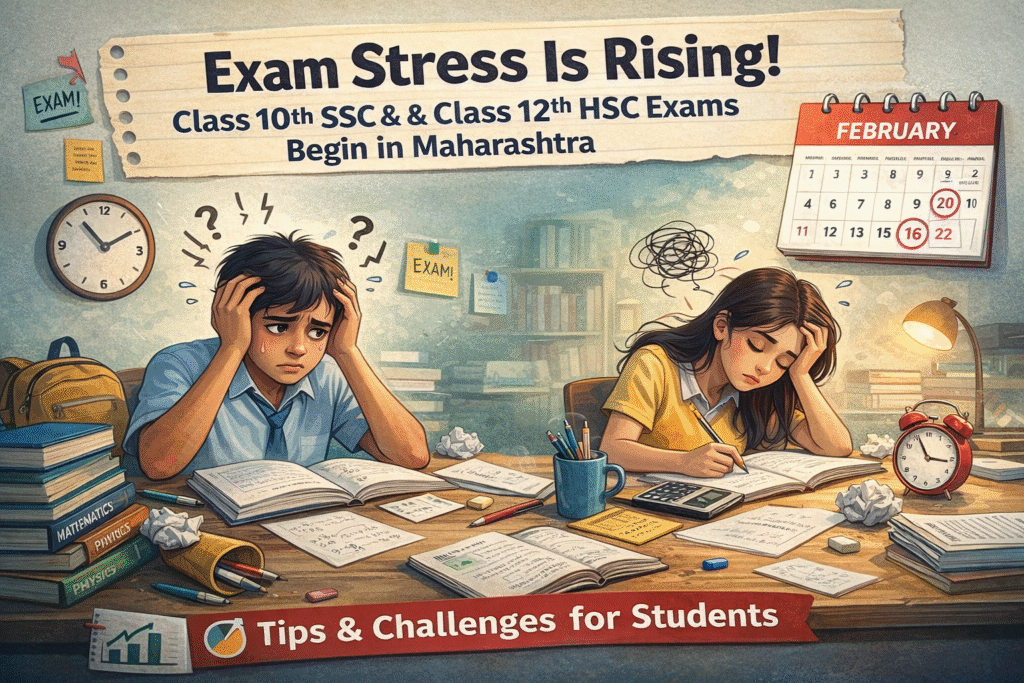
As February approaches, anxiety levels rise sharply in thousands of homes across Maharashtra. I see this every year in my clinic—and 2026 is no different.
For clarity, here are the exam timelines first.
Maharashtra Board Exam Dates (2026)
- Class 10 – SSC (MSBSHSE):
20 February 2026 to 18 March 2026 - Class 12 – HSC (MSBSHSE):
Mid-February to mid-March 2026 (expected window, as per annual pattern)
With exams starting almost back-to-back, students get very little psychological breathing space.
Why Exam Stress Peaks in 10th and 12th Standard
Class 10 and 12 are not stressful only because of the syllabus.
They are stressful because they are treated as “life-deciding” exams.
Students are told—directly or indirectly:
- “This will decide your future”
- “Your career depends on these marks”
- “One mistake and everything is over”
For a developing adolescent brain, this level of pressure is overwhelming.
Common Problems Faced by Students During Board Exams
These are clinical observations, not assumptions.
1. Fear of Forgetting Everything
Many students say:
“I know the answers at home, but my mind goes blank in exams.”
This is anxiety-induced memory block, not lack of preparation.
2. Poor Concentration
- Sitting for hours but studying little
- Reading without understanding
- Constant urge to check phone
Stress reduces attention span significantly.
3. Sleep Disturbance
Statistics from Indian adolescent studies show:
- 40–60% students report poor sleep during board exams
- Late-night studying + anxiety = non-restorative sleep
Poor sleep directly reduces:
- Recall
- Speed
- Accuracy
4. Physical Symptoms
Very common during exams:
- Headache
- Stomach pain
- Nausea
- Chest tightness
- Tremors before exams
Many parents first visit a physician, not realizing this is exam anxiety.
5. Emotional Changes
- Irritability
- Crying spells
- Silence or withdrawal
- Sudden anger
These are often misunderstood as “attitude problems”.
Common Exam-Related Disorders Seen Clinically
Not all stress is illness—but some students do develop disorders.
1. Exam Anxiety Disorder
- Panic before or during exams
- Blank mind despite preparation
- Rapid heartbeat, sweating
Seen in 15–25% board students in urban India.
2. Adjustment Disorder
- Emotional breakdown triggered by exam pressure
- Decline in performance despite effort
3. Sleep Disorders (Acute Insomnia)
- Difficulty falling asleep
- Early morning anxiety
- Daytime fatigue
4. Depression (Mild to Moderate)
- Loss of motivation
- Hopelessness
- “I can’t do this anymore” thoughts
Needs early attention, not scolding.
Subjects Students Find Most Difficult (Based on Patterns)
Class 10 (SSC)
- Mathematics – fear, time pressure, calculation errors
- Science (Physics & Chemistry) – numericals, diagrams
- Algebra & Geometry – concept clarity issues
Class 12 (HSC)
- Physics – numericals, derivations
- Mathematics – lengthy problems, speed
- Chemistry – organic reactions, memory load
- Accountancy – accuracy, time management
Across India, surveys consistently show:
- Maths and Physics are the most anxiety-provoking subjects
- Language subjects cause stress mainly due to writing speed and presentation
Common Mistakes Students Make During Exam Time
- Trying to study everything at the last moment
- Ignoring revision and focusing only on new topics
- Studying without writing practice
- Irregular sleep routine
- Comparing themselves with toppers
These mistakes are stress-driven, not stupidity.
Common Mistakes Parents Make (Unknowingly)
This section is important.
1. Constant Monitoring
- “What did you study today?”
- “Why are you slow?”
This increases anxiety, not discipline.
2. Comparison
- With neighbors’ children
- With cousins
- With previous batch toppers
Comparison damages confidence permanently.
3. Fear-Based Motivation
- “If you don’t score well…”
- “Think of our reputation…”
Fear blocks learning.
4. Ignoring Emotional Signals
Parents often address marks, not mood.
A distressed child cannot perform well, no matter how intelligent.
What Actually Helps Students Now (Practical Only)
1. Revision Over New Learning
At this stage:
- Revise what is already studied
- Strengthen scoring areas
- Avoid syllabus panic
2. Writing Practice Daily
Even 1–2 answers daily improves:
- Speed
- Confidence
- Presentation
3. Fixed Sleep–Wake Time
- Sleep before midnight
- Minimum 7 hours
- No late-night “panic studying”
Sleep improves memory consolidation.
4. Limited Phone Use
Phones increase:
- Comparison
- Anxiety
- Distraction
Parents must model this behavior too.
When to Seek Help from a Psychiatrist
Please seek professional help if:
- Panic attacks occur before exams
- Sleep is severely disturbed
- Student refuses to study or go to exam
- Frequent crying or emotional shutdown
- Physical symptoms with no medical cause
- Thoughts like “I can’t handle this”
Early intervention prevents long-term harm.
How a Psychiatrist Can Help Improve Exam Performance
Contrary to myths, psychiatric help is not about labels.
A psychiatrist helps by:
- Reducing anxiety so memory works better
- Improving sleep quality
- Teaching focus and emotional regulation
- Supporting parents in communication
- Using medication only when necessary, often short-term
Many students show visible academic improvement within weeks.
Final Words to Students
One exam does not define your worth.
But your mental health will define how you handle life ahead.
Final Words to Parents
Marks matter—but a calm, emotionally supported child performs better.
Support first. Results follow.
Written from clinical experience with students and families during board examinations.
(This blog is for educational purposes and does not replace professional consultation.)
Dr. Rameez Shaikh (MBBS, MD, MIPS) is a consultant Psychiatrist, Sexologist & Psychotherapist in Nagpur and works at Mind & Mood Clinic. He believes that science-based treatment, encompassing spiritual, physical, and mental health, will provide you with the long-lasting knowledge and tool to find happiness and wholeness again.
Dr. Rameez Shaikh, a dedicated psychiatrist , is a beacon of compassion and understanding in the realm of mental health. With a genuine passion for helping others, he combines his extensive knowledge and empathetic approach to create a supportive space for his patients.