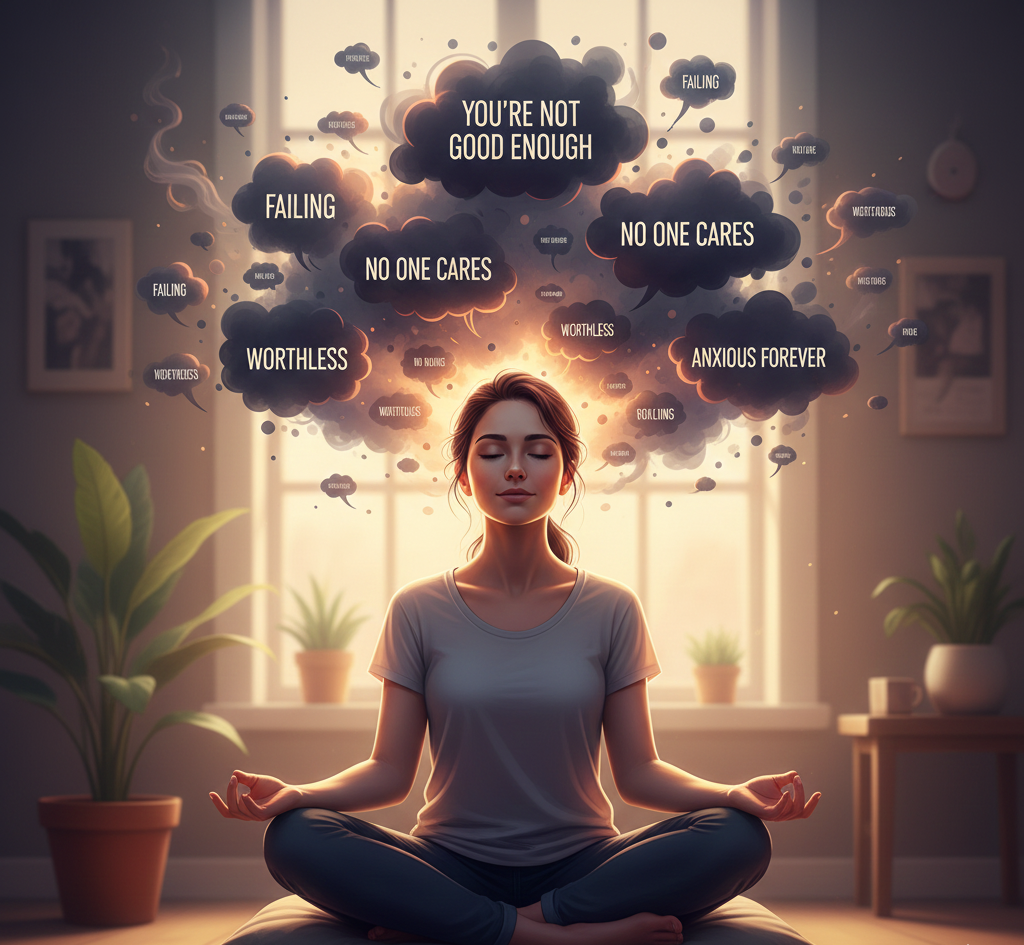
If you live with OCD, you already know this truth:
The thoughts don’t ask for permission.
They just appear.
Sudden. Disturbing. Loud. Repetitive.
And the worst part?
They feel so real, even when you know they don’t match who you truly are.
As a psychiatrist, one of the most painful things I see in OCD patients is not the thoughts themselves — but the shame and fear that follows them.
So let’s talk about this honestly.
🧠 What Are “Negative Thoughts” in OCD?
In OCD, negative thoughts are usually intrusive thoughts.
They are:
- unwanted
- repetitive
- distressing
- ego-dystonic (they go against your values)
Examples patients often tell me:
“What if I hurt someone?”
“What if I contaminate my family?”
“What if I’m a bad person for even thinking this?”
“What if I lose control?”
These thoughts are not intentions.
They are false alarms from the brain.
🔁 Why OCD Thoughts Feel So Sticky
Here’s the cruel trick OCD plays:
A normal brain ignores random thoughts.
An OCD brain reacts to them.
The moment you think:
“Why did I think this?”
OCD says:
“See? This must be important.”
And the loop begins.
Thought → Anxiety → Compulsion → Temporary relief → Thought returns.
🧠 The Biology Behind OCD Thoughts
OCD is linked to overactivity in:
- the orbitofrontal cortex (error detection)
- the anterior cingulate cortex (anxiety signal)
- the basal ganglia (habit loop)
In simple words:
Your brain keeps sending a “something is wrong” signal, even when nothing is actually wrong.
That’s why reassurance never lasts.
😞 Common Emotional Effects I See in Patients
From real clinical experience, OCD negative thoughts often cause:
- constant guilt
- fear of being “bad”
- mental exhaustion
- loss of confidence
- avoidance of loved ones
- silent suffering
One patient once told me:
“Doctor, I’m scared of my own mind.”
That sentence stays with you.
🚫 Important Truth You Must Know
Having a thought does NOT mean you want it.
Having a thought does NOT mean you will act on it.
Having a thought does NOT define your character.
In fact, the more a thought disturbs you, the more it proves how strongly you value the opposite.
🧠 How Treatment Actually Helps
Effective OCD treatment focuses on changing your response, not removing thoughts.
At our clinic, we commonly use:
- CBT to challenge fear logic
- ERP to teach your brain tolerance
- Thought defusion techniques
- Medication (when needed) to calm the loop
When patients stop fighting thoughts, something surprising happens:
The thoughts lose power.
🌱 A Gentle Reminder
You are not weak.
You are not broken.
You are not your thoughts.
OCD attacks what matters most to you — that’s why it hurts.
❓ FAQs — Negative Thoughts in OCD
1. Are OCD thoughts dangerous?
No. OCD thoughts feel dangerous but are not predictive of behavior.
2. Why do my thoughts feel so real?
Because anxiety activates emotional brain circuits, making thoughts feel urgent and believable.
3. Should I try to stop these thoughts?
Trying to stop them usually makes them stronger. Learning to allow them without reacting is more effective.
4. Does having these thoughts mean I secretly want them?
Absolutely not. OCD thoughts are ego-dystonic — they go against your values.
5. Can OCD thoughts go away completely?
They may reduce significantly, but the real goal is losing fear of them, not eliminating them.
6. Do I need medication for OCD thoughts?
Not always. Many patients improve with therapy alone; some benefit from combined treatment.
7. Will therapy make me face my worst fears?
Gradually, safely, and with full support — never forcefully.
📞 When to Reach Out
If negative thoughts are:
- controlling your day
- affecting sleep or relationships
- making you afraid of yourself
Please don’t suffer silently.
Mind & Mood Clinic, Nagpur (India)
Dr. Rameez Shaikh, MD
Psychiatrist & Counsellor
📞 +91-8208823738
Help exists — and it works.
⚠️ Disclaimer
This blog is for educational purposes only and does not replace professional medical or psychological consultation. Please consult a qualified mental health professional for diagnosis and treatment.

Dr. Rameez Shaikh (MBBS, MD, MIPS) is a consultant Psychiatrist, Sexologist & Psychotherapist in Nagpur and works at Mind & Mood Clinic. He believes that science-based treatment, encompassing spiritual, physical, and mental health, will provide you with the long-lasting knowledge and tool to find happiness and wholeness again.
Dr. Rameez Shaikh, a dedicated psychiatrist , is a beacon of compassion and understanding in the realm of mental health. With a genuine passion for helping others, he combines his extensive knowledge and empathetic approach to create a supportive space for his patients.