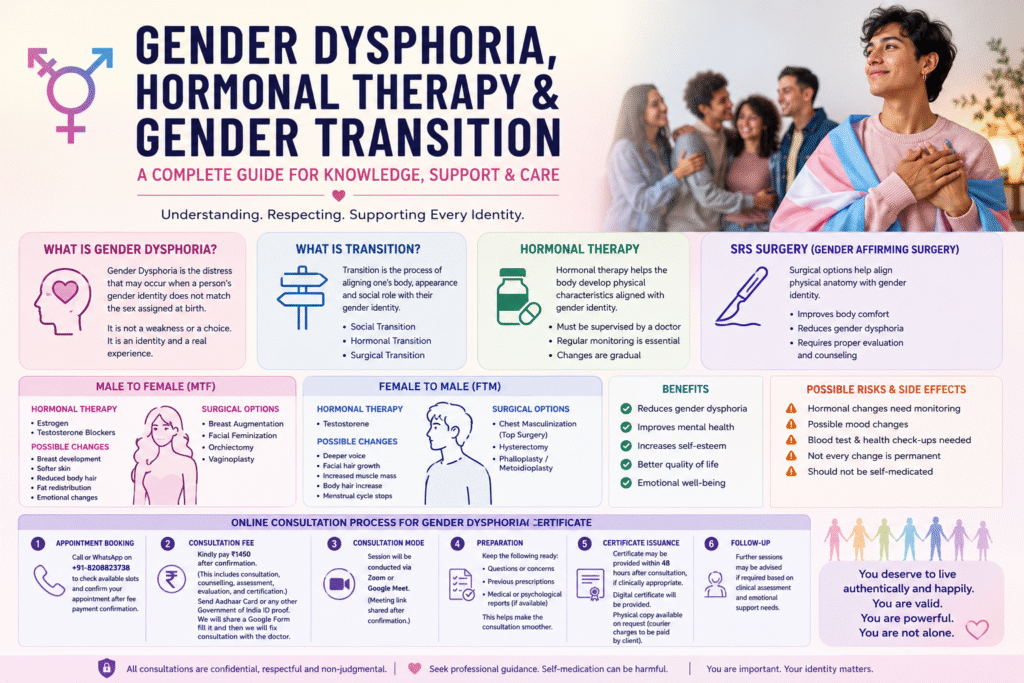
For many people, gender identity is something that naturally feels comfortable and unquestioned. But for others, there may be a deep and persistent feeling that the gender assigned at birth does not match who they truly feel they are internally.
This experience can be confusing, emotionally painful, isolating, and difficult to explain — especially in societies where transgender identities are misunderstood or judged harshly.
Many individuals silently struggle for years with questions like:
- “Why do I feel uncomfortable in my own body?”
- “Am I transgender?”
- “Is this just confusion or something real?”
- “Can hormonal therapy help?”
- “Do I need surgery?”
- “Will doctors judge me?”
- “How can I get a gender dysphoria certificate?”
- “What happens during consultation?”
- “Can I transition safely?”
These are valid and important questions.
As psychiatrists and mental health professionals, one of the most important responsibilities is creating a safe, respectful, non-judgmental environment where individuals can openly discuss gender identity without fear, shame, or humiliation.
This article explains gender dysphoria, hormonal therapy, gender transition, surgery, consultation process, commonly asked questions, and what to expect emotionally and medically.
What is Gender Dysphoria?
Gender Dysphoria refers to the emotional distress a person may experience when their gender identity does not align with the sex assigned to them at birth.
For example:
- A person assigned male at birth may internally identify as female.
- A person assigned female at birth may internally identify as male.
The distress may involve:
- Discomfort with body characteristics
- Feeling emotionally disconnected from assigned gender roles
- Anxiety or depression related to gender identity
- Feeling unhappy being addressed as assigned gender
- Strong desire to live as another gender
- Distress during puberty changes
- Emotional suffering related to social expectations
Not every transgender individual experiences severe dysphoria.
And being transgender itself is not a mental illness.
The distress, confusion, emotional suffering, and impairment caused by the mismatch is what may require psychological support and evaluation.
Understanding Gender Transition
Transition refers to the process through which a person begins aligning their life and appearance with their gender identity.
Every transition journey is different.
Some individuals:
- Socially transition only
- Take hormonal therapy
- Undergo surgery
- Or choose no medical interventions at all
There is no “correct” or “mandatory” path.
Transition is deeply personal.
Social Transition
Social transition may include:
- Changing name
- Changing clothing style
- Using preferred pronouns
- Changing hairstyle
- Presenting socially in affirmed gender role
- Updating identity documents
For some individuals, social transition itself significantly reduces emotional distress.
Hormonal Therapy: What It Means
Hormonal therapy uses medicines to help the body develop physical characteristics closer to the person’s affirmed gender identity.
Hormonal therapy should always be medically supervised and monitored.
Self-medication can be dangerous.
Male-to-Female (MTF) Hormonal Therapy
For individuals assigned male at birth who identify as female, treatment may involve:
- Estrogen
- Testosterone blockers
Possible physical changes include:
- Softer skin
- Breast development
- Reduced body hair
- Reduced muscle mass
- Fat redistribution
- Emotional changes
- Reduced spontaneous erections
Some changes are gradual and may take months to years.
Female-to-Male (FTM) Hormonal Therapy
For individuals assigned female at birth who identify as male, treatment may involve:
- Testosterone
Possible changes include:
- Deeper voice
- Facial hair growth
- Increased muscle mass
- Increased body hair
- Stopping menstrual cycles
- Fat redistribution
Again, changes happen gradually over time.
Benefits of Hormonal Therapy
Research and clinical experience suggest that gender-affirming treatment may help reduce:
- Gender dysphoria
- Anxiety
- Depression
- Emotional distress
- Suicidal thoughts
- Social discomfort
Many individuals report feeling emotionally calmer and more authentic after medically supervised transition-related care.
Side Effects and Risks of Hormonal Therapy
Hormonal therapy also carries medical risks and requires regular monitoring.
Possible Risks in MTF Therapy
- Blood clot risk
- Weight changes
- Fertility reduction
- Mood fluctuations
- Sexual side effects
- Liver or metabolic changes
Possible Risks in FTM Therapy
- Acne
- Hair thinning or hair loss
- Increased cholesterol
- Blood pressure changes
- Mood fluctuations
- Increased red blood cell count
Regular blood tests and medical follow-up are important.
What is SRS Surgery?
SRS stands for:
Sex Reassignment Surgery
(also called Gender-Affirming Surgery)
These surgeries help align physical anatomy with gender identity.
Not everyone chooses surgery.
And surgery is not necessary for someone’s identity to be valid.
Common Male-to-Female Surgeries
May include:
- Breast augmentation
- Facial feminization
- Orchiectomy
- Vaginoplasty
Common Female-to-Male Surgeries
May include:
- Chest masculinization (“top surgery”)
- Hysterectomy
- Phalloplasty
- Metoidioplasty
Can Someone Undergo SRS Without Hormonal Therapy?
In some situations, yes — but requirements vary depending on:
- Surgeon
- Medical evaluation
- Mental health assessment
- Individual circumstances
Some surgeons require hormonal therapy before surgery. Others assess case-by-case.
A proper evaluation is necessary.
How Long Does Hormonal Therapy Continue?
Hormonal therapy duration differs for each individual.
Some continue treatment long-term or lifelong under medical supervision.
Certain physical changes become partially or permanently irreversible over time.
This is why informed consent and proper counselling are essential.
Common Emotional Struggles in Gender Dysphoria
Many individuals silently experience:
- Anxiety
- Depression
- Fear of rejection
- Family conflict
- Social isolation
- Self-hatred
- Fear about future relationships
- Fear of being judged by doctors
- Fear about appearance changes
- Religious or cultural guilt
Unfortunately, many people delay seeking help because of stigma.
What Questions Might a Doctor Ask During Evaluation?
A good LGBTQ-friendly mental health professional is not there to “judge” or “test” someone unfairly.
The purpose of assessment is understanding, support, clarity, safety, and informed decision-making.
Common questions may include:
- When did you first notice gender-related feelings?
- How long have these feelings been present?
- What causes distress or discomfort?
- Have you socially transitioned?
- How do family and friends react?
- Have you experienced depression or anxiety?
- What are your expectations from hormonal therapy?
- Are you aware of possible risks and long-term effects?
- Have you previously taken hormones?
- Are there any medical conditions or psychiatric concerns?
These questions help ensure safe and appropriate care.
Importance of LGBTQ-Friendly Doctors
Many transgender individuals fear discrimination during consultation.
A supportive and LGBTQ-friendly doctor should ideally:
- Maintain confidentiality
- Use respectful language
- Avoid humiliation or moral judgment
- Explain treatment clearly
- Focus on informed consent
- Provide emotional support
- Help patients make safe decisions
Mental healthcare should feel safe, respectful, and humane.
Affordable Mental Health Support Matters
Unfortunately, many people in the LGBTQ community delay treatment due to:
- Fear
- Family pressure
- Financial concerns
- Social stigma
Because of this, some professionals intentionally try to keep consultation fees relatively affordable to improve accessibility for individuals genuinely seeking help and guidance.
The goal should not only be certification — but emotional support, clarity, and safe transition-related care.
🌈 Online Consultation Process for Gender Dysphoria Certificate
1. Appointment Booking
Call or WhatsApp on +91-8208823738 to check available appointment slots and confirm your consultation after fee payment confirmation.
2. Consultation Fee
Kindly pay ₹1450 after confirmation.
(This includes consultation, counselling, assessment, evaluation, and certification.)
After confirmation:
- Send Aadhaar Card or any Government of India approved ID proof.
- A Google Form will be shared for basic clinical details.
- Consultation timing will then be scheduled with the doctor.
3. Consultation Mode
Session will be conducted via:
- Zoom
or - Google Meet
(Meeting link will be shared after confirmation.)
4. Preparation Before Consultation
Keep the following ready:
- Questions or concerns
- Previous prescriptions
- Medical reports
- Psychological records (if available)
This helps make consultation smoother and more productive.
5. Certificate Issuance
Certificate may be issued within 48 hours after consultation, if clinically appropriate following assessment.
A digital certificate will be provided.
If a physical hard copy is required:
- It can be couriered to the client.
6. Follow-Up Sessions
Further counselling or follow-up sessions may be advised depending on:
- Emotional support needs
- Psychological assessment
- Hormonal therapy planning
- Mental health concerns
- Family-related stress
Important Things to Know Before Hormonal Therapy
Before starting hormones:
- Do not self-medicate
- Avoid buying hormones online without supervision
- Get proper blood tests
- Understand fertility implications
- Discuss long-term effects
- Inform doctors about medical illnesses
- Discuss expectations realistically
Safe transition is informed transition.
Frequently Asked Questions (FAQs)
Is being transgender a mental illness?
No. Being transgender itself is not a mental illness. Gender dysphoria refers to the distress that may occur due to mismatch between gender identity and assigned sex.
Can hormonal therapy completely change the body?
Hormones can create significant physical changes, but effects vary from person to person depending on age, genetics, duration, and body response.
Are hormonal changes reversible?
Some changes are reversible if hormones are stopped early, while others become partially or permanently irreversible over time.
Will the doctor force surgery or hormones?
No ethical doctor should force treatment. Decisions should be voluntary, informed, and individualized.
Can someone socially transition without surgery?
Yes. Many individuals socially transition without undergoing surgery.
Is psychiatric evaluation compulsory?
Requirements differ depending on hormones, surgery, legal documentation, and healthcare providers. Mental health assessment often helps ensure informed and safe care.
Will my information remain confidential?
Ethical medical practice requires maintaining patient confidentiality and privacy.
Can someone regret transition?
Some individuals may experience regret or emotional difficulties, which is why proper evaluation, counselling, and informed consent are important before irreversible interventions.
Can I take hormones without a prescription?
This is strongly discouraged. Hormones can have serious medical risks if taken without proper supervision.
Final Thoughts
Gender identity journeys are often emotionally complex, deeply personal, and shaped by years of silent struggle.
For many individuals, simply finding a safe doctor who listens respectfully can itself feel life-changing.
No one should feel ashamed for asking questions about their identity, body, or emotional distress.
Good mental healthcare is not about judgment.
It is about understanding, safety, informed choices, and emotional support.
Whether someone chooses:
- Social transition
- Hormonal therapy
- Surgery
- Or no medical intervention at all
their dignity and humanity deserve respect.
Disclaimer
This article is for educational and awareness purposes only and should not replace professional psychiatric, endocrinological, surgical, or medical advice. Hormonal therapy and gender-affirming procedures should only be undertaken after appropriate consultation with qualified professionals.
Dr. Rameez Shaikh, MBBS, MD
Psychiatrist & Counsellor
Mind & Mood Clinic
About Dr. Rameez Shaikh
Dr. Rameez Shaikh, MBBS, MD (Psychiatrist & Counsellor), aims to provide a respectful, confidential, and LGBTQ-friendly consultation environment where individuals can openly discuss gender identity, dysphoria, emotional struggles, transition-related concerns, anxiety, or depression without fear of judgment. The focus is on supportive and ethical mental healthcare, informed decision-making, and helping individuals feel heard and understood. Efforts are also made to keep consultations reasonably affordable so that mental healthcare and gender-related guidance remain accessible to people genuinely seeking help and support.

Dr. Rameez Shaikh (MBBS, MD, MIPS) is a consultant Psychiatrist, Sexologist & Psychotherapist in Nagpur and works at Mind & Mood Clinic. He believes that science-based treatment, encompassing spiritual, physical, and mental health, will provide you with the long-lasting knowledge and tool to find happiness and wholeness again.
Dr. Rameez Shaikh, a dedicated psychiatrist , is a beacon of compassion and understanding in the realm of mental health. With a genuine passion for helping others, he combines his extensive knowledge and empathetic approach to create a supportive space for his patients.