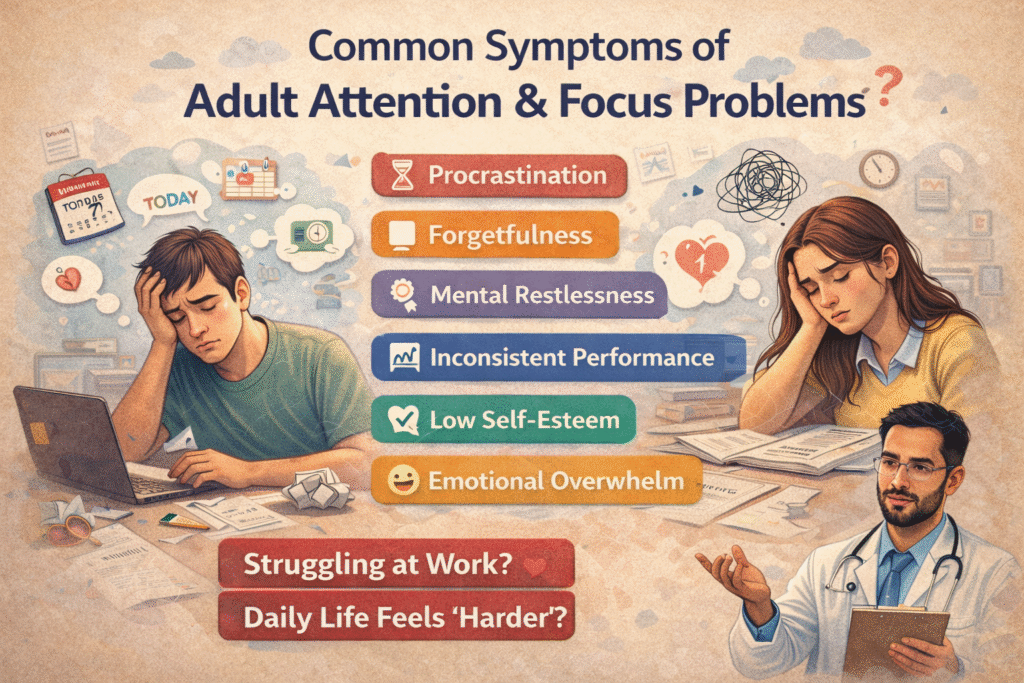
A quiet look at a very common adult struggle
Many adults walk into my clinic saying the same thing, in different words:
“Doctor, I’m intelligent, I try hard… but something is always off.”
They are not lazy.
They are not careless.
They are not irresponsible.
Yet their lives feel chaotic, exhausting, and constantly behind.
This blog is about that experience—without labels—because many people live with it for years without realizing help exists.
The Everyday Struggles No One Sees
1. Difficulty Sustaining Attention
You start tasks with full intention:
- Reading a report
- Studying
- Listening in meetings
But within minutes:
- Mind drifts
- You re-read the same line
- You miss key points
Others think you’re not serious.
You know you are—but your brain won’t cooperate.
2. Chronic Procrastination (Despite Pressure)
Deadlines don’t motivate you early.
They terrify you at the last moment.
You keep thinking:
“I’ll start after a short break.”
Suddenly it’s midnight.
Then panic sets in.
This is not poor time management.
It’s a difficulty activating focus on demand.
3. Forgetfulness That Causes Embarrassment
- Forgetting appointments
- Missing calls
- Misplacing keys, wallets, documents
- Remembering tasks only after consequences occur
You may hear:
“How can you forget such simple things?”
Over time, shame builds.
4. Mental Restlessness
Even while sitting still, the mind is noisy:
- Multiple thoughts at once
- Jumping from idea to idea
- Difficulty relaxing
Sleep often becomes difficult—not because of worry, but because the brain doesn’t slow down.
5. Emotional Overload
Small things feel overwhelming:
- Criticism hurts deeply
- Frustration comes fast
- Mood swings happen quickly
You may feel:
“I overreact, but I can’t stop myself.”
6. Inconsistent Performance
This is one of the most confusing parts.
Some days:
- You are brilliant
- Hyper-focused
- Extremely productive
Other days:
- Nothing works
- Even simple tasks feel heavy
People call it “inconsistency.”
Clinically, it’s a regulation problem, not motivation.
Real-Life Examples (Common in India)
- A software professional who performs well but misses meetings and deadlines
- A doctor or student who studies for hours but retains little
- A homemaker overwhelmed by daily routines despite effort
- An entrepreneur full of ideas but unable to execute consistently
- A professional labeled “careless” despite high intelligence
Most of them grow up believing:
“Something is wrong with my character.”
That belief causes more damage than the symptoms themselves.
Why These Problems Are Often Missed
- School years may pass due to intelligence compensating for difficulty
- Families mistake it for laziness or attitude
- Adults learn coping tricks—but burn out internally
- Many think mental health help is only for “serious illness”
So they struggle silently.
The Hidden Psychological Cost
Over time, untreated struggles can lead to:
- Chronic stress
- Low self-esteem
- Anxiety
- Depression
- Relationship conflicts
- Career stagnation despite ability
The emotional pain often becomes bigger than the attention problem itself.
When Should You Consider Professional Help?
You should consider consulting a psychiatrist if:
- These patterns exist since childhood or early adulthood
- You try harder than others but achieve less
- Stress and self-criticism are increasing
- Sleep, work, or relationships are affected
- You feel mentally exhausted by daily life
This is not about labels.
It’s about quality of life.
How a Psychiatrist Helps (Practically)
A psychiatrist does not judge or blame.
They help by:
- Understanding how your brain processes attention and emotions
- Identifying patterns that are neurological, not moral
- Treating associated anxiety, sleep issues, or mood problems
- Using structured therapy strategies
- Prescribing medication only if required, and carefully
- Helping you rebuild confidence and self-trust
Many adults say:
“For the first time, things make sense.”
An Important Truth
If you’ve spent your life feeling:
- Behind others despite effort
- Mentally exhausted by simple tasks
- Ashamed of your inconsistency
You are not broken.
Your brain just works differently—and different does not mean defective.
Help doesn’t change who you are.
It helps you finally work with your brain, not against it.
Written from clinical experience with adults who struggled silently for years before understanding themselves.
(This blog is for educational purposes and not a substitute for professional consultation.)

Dr. Rameez Shaikh (MBBS, MD, MIPS) is a consultant Psychiatrist, Sexologist & Psychotherapist in Nagpur and works at Mind & Mood Clinic. He believes that science-based treatment, encompassing spiritual, physical, and mental health, will provide you with the long-lasting knowledge and tool to find happiness and wholeness again.
Dr. Rameez Shaikh, a dedicated psychiatrist , is a beacon of compassion and understanding in the realm of mental health. With a genuine passion for helping others, he combines his extensive knowledge and empathetic approach to create a supportive space for his patients.